


Bodily Injury Settlement Calculator
Estimate your bodily injury claim’s worth and what you may keep after fees and medical liens.
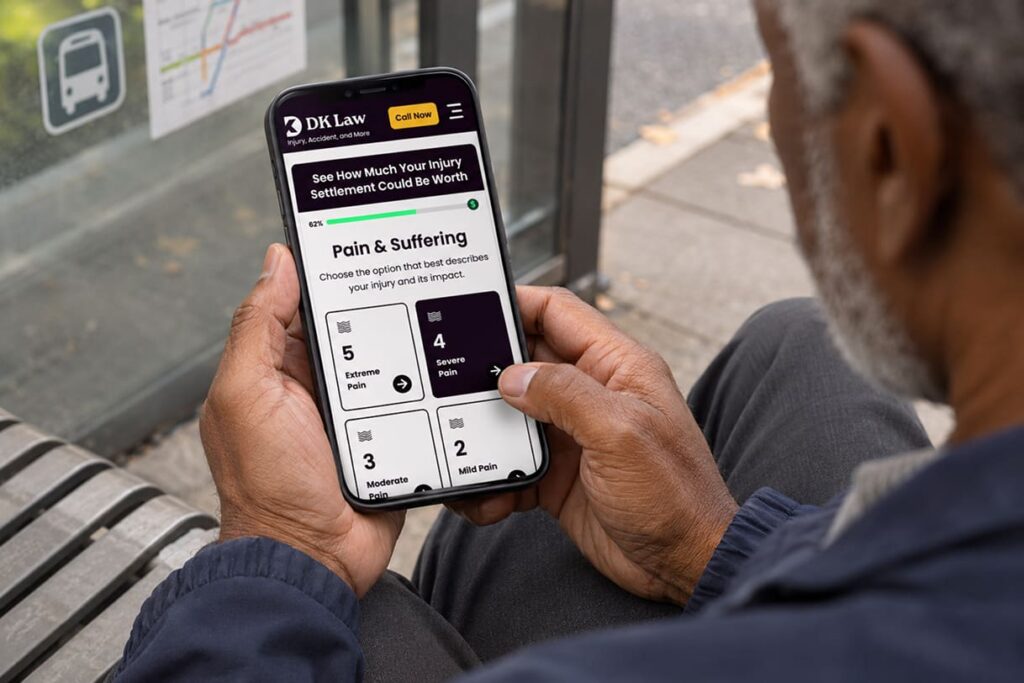
See How Much Your Injury Settlement Could be Worth
Get Started
What type of accident were you involved in?
Valid Auto Insurance
Did you have valid auto insurance at the time of the accident?
Emergency Response
Did an ambulance transport you after the injury?
Employment Details
What best describes your employment status at the time of the injury?
经济损失
Calculate your financial losses.
Pain & Suffering
Choose the option that best describes your injury and its impact.
Liability Assessment
Indicate how much of the accident you believe was your fault.
Not at fault
Your Estimated Settlement Value
Please note: This is only an estimate.
Estimated Total Compensation
$0
经济损失
痛苦与苦难
Itemized Calculation Breakdown
经济损失
Pain & Suffering
Liability Adjustment
This calculator provides only an estimate based on typical settlement formulas used in California personal injury cases. Every case is unique, and actual settlement values can vary significantly based on specific facts, evidence quality, insurance coverage, and negotiation dynamics. This tool is not legal advice. For an accurate evaluation of your case, please consult with a qualified California personal injury attorney.
A bodily injury claim puts a dollar figure on what the injury has cost you. That includes your treatment, the paychecks you missed, and the months you spent unable to do things you never used to think twice about.
要点
- A bodily injury settlement is economic damages (medical costs, lost income) plus non-economic damages (pain, limitation, loss of enjoyment), reduced by your share of fault.
- The multiplier used for pain and suffering is a negotiating convention. No California statute sets it, and no court is required to accept it.
- California limits recoverable medical damages to the amount paid or still owed, not the amount billed. The two numbers are often far apart.
- A claim rarely pays more than the available insurance, no matter what the damages add up to.
- What lands in your account is the settlement minus attorney fees, case costs, and any medical liens, and liens get reduced by statute before anyone touches your share.
Why the first offer comes in below the estimate
An opening offer is a negotiating position, not an assessment. Claims get evaluated against what an insurer expects to pay if the case goes nowhere, which is a different question from what the injury costs you. The gap between those two numbers is the thing a claim is built to close.
Three levers push an opening number down, and all three are legitimate arguments that must be answered rather than complained about.
The first is the medical total. California allows recovery of what was paid or is still owed, so a carrier reviewing a file will work from paid amounts and write off the rest. The second is fault, since any percentage assigned to you comes straight off the top. The third is the policy limit, which caps what any insurer pays regardless of how the damages add up.
There is also a documented history of claims software being tuned inconsistently. In 2010, Allstate paid $10 million to 45 states to resolve a multistate market conduct examination into how it tuned the Colossus bodily injury evaluation system and agreed to stop requiring adjusters to settle claims solely at the value the software returned. Regulators found inconsistent tuning across claims regions. They did not find systemic underpayment.
What your file must show to support the number
An estimate is only worth what the documentation behind it will support. Six things carry most of the weight, and the absence of any one of them is the most common reason a strong claim settles soft.
- A diagnosis, written down, early. An injury that first appears in the record three weeks after the incident invites an argument about what caused it.
- Treatment that matches the complaint. Consistent care over a defined period reads differently from four scattered visits across six months.
- Objective findings where they exist. Imaging, range of motion measurements, and neurological testing move a file further than a pain score does.
- A prognosis. A treating physician stating what is permanent and what is not is the single most useful document in a non-economic damages argument.
- Wage documentation. Pay stubs, a letter from an employer, or tax returns for self-employed claimants.
- An honest account of what came before. Pre-existing conditions do not sink a claim. California permits recovery for the aggravation of a prior condition. Concealing one does real damage.
Does more treatment raise a bodily injury settlement?
More treatment raises the economic damages figure, which raises the multiplier base, so the arithmetic says yes. The practical answer? Treatment that a physician ordered, and that addresses a documented injury supports a claim. Treatment that appears to have been generated for the file does the opposite, and gaps in care get read as recovery whether that is what happened.
Where treatment genuinely changes, the picture is in what it reveals. An MRI that shows a disc protrusion, an epidural injection that becomes necessary, a referral from a primary care doctor to an orthopedic surgeon: each of those shifts the injury into a different tier because a specialist put it there.
Length matters too, though not in a straight line. A soft tissue injury treated for six weeks and a soft tissue injury treated for eight months are different claims, assuming the records explain why the second one took that long.
Why your medical bills and your medical damages are different numbers
California caps recoverable medical damages at the amount actually paid or still owed, not the amount a provider billed. The California Supreme Court settled this in Howell v. Hamilton Meats, where a plaintiff's bills totaled $189,978.63 and the amount her insurer actually paid was roughly $130,000 less.
So, a $40,000 stack of bills can be a $12,000 damages figure if a health insurer negotiated the rates down. When you enter past medical expenses into the calculator, the number that will hold up is what was paid or what remains owed.
Claimants treating on a lien are in a different position, since nothing was written off and the full amount is still owed. Uninsured claimants can also prove the reasonable value of care through physician testimony rather than being held to a discounted rate.
How much of a $25,000 settlement do you actually keep?
The settlement figure and the deposit are two different numbers. Subtract the attorney fee, then case costs, then any medical liens, and what remains is yours.
Here is the arithmetic on a $25,000 settlement, using an assumed one third contingency fee and $1,000 in case costs. The fee comes to $8,333. Costs take another $1,000. That leaves $15,667 before liens.
Liens can often be reduced, which can change how much you keep. If Medi-Cal paid $6,000 of your treatment, its recovery may first be limited to the portion of the settlement that represents medical expenses. It is then reduced by 25% for its share of attorney fees, plus a pro rata share of litigation costs. A separate statutory cap also limits Medi-Cal to no more than half of what remains after fees, costs, and any medical expenses you paid yourself. Medicare’s recovery is also reduced for its share of procurement costs.
The $6,000 figure is only an example. Fee percentages vary by firm and whether a case settles before or after a lawsuit is filed, and the final lien amount depends on the facts of each case.
Is a bodily injury settlement taxable?
Compensation for physical injury is generally not taxable. Section 104(a)(2) of the Internal Revenue Code excludes damages received on account of personal physical injuries or physical sickness from gross income, and that covers medical costs, lost wages tied to the injury, and pain and suffering.
Four exceptions matter. Punitive damages are taxable even when awarded in a physical injury case, and interest on a judgment is taxable as interest income.
Emotional distress damages that did not originate in a physical injury are taxable. So is any portion of a settlement that reimburses medical expenses you already deducted on a prior return, to the extent that deduction gave you a tax benefit.
The IRS covers the whole thing in Publication 4345. Worth reading before you sign a release, since how a settlement is allocated across categories affects what you owe.
Common questions
How is pain and suffering calculated in a bodily injury claim? Most negotiations apply a multiplier, usually between 1.5 and 5, to the medical damages total. The multiplier has no legal authority behind it. It is a shorthand that both sides use because it gives them a common starting point, and it tends to climb with permanence, objective findings, and specialist involvement.
Does being partly at fault end my claim? No. California uses pure comparative fault, so damages are reduced by your percentage of responsibility and nothing more. A claimant found 70% at fault still recovers 30% of the damages.
What if the other side has no insurance? Your own uninsured motorist coverage becomes the source of payment if you carry it. The claim runs against your own insurer but is still evaluated on the same damages.
How long does a bodily injury settlement take? Most claims are not worth evaluating until treatment ends, or a physician states what is permanent, because that is when the damages stop moving. Settling before then means settling without knowing the number.
Do I need a lawyer for a small claim? Not always. Where representation tends to matter is on lien reduction, policy limit demands, and claims involving disputed fault or a pre-existing condition.
Get a read on your own numbers
The calculator gives you a range. Where your claim falls within it depends on what your medical records show about how your injuries affect your daily function, whether your treatment became more intensive, and what coverage is available. An attorney who handles injury claims can help you evaluate each of these.
DK Law handles bodily injury claims throughout California. Call 800-719-9779 for a free consultation or request a case evaluation.
No cost unless we recover for you.
按您的需求查找
Whether you're searching by location or case type, we'll help you get exactly where you need to be.
查找附近的办公室
浏览我们服务的所有城市和县。 看看我们的律师每天都在哪里赢得案件。

了解我们的业务领域
从车祸到过失致死,我们拥有处理各类复杂案件的经验与实力。

DK 一路走来
从立案到获赔,我们与您并肩到底
预约免费咨询
在专家法律咨询处获得专业法律建议 零成本。.
At DK Law we're with you - 路并肩到底。
今天就预约免费咨询!

事故发生后时间很重要
事故发生后越早与律师联系,你的索赔就越有胜算。及早行动有助于保全证据并维护你的权益。.
无需支付费用即可获得法律援助 | 24×7全天候服务