


Pain After a Car Accident: When It’s Normal, When to Worry, and What to Do
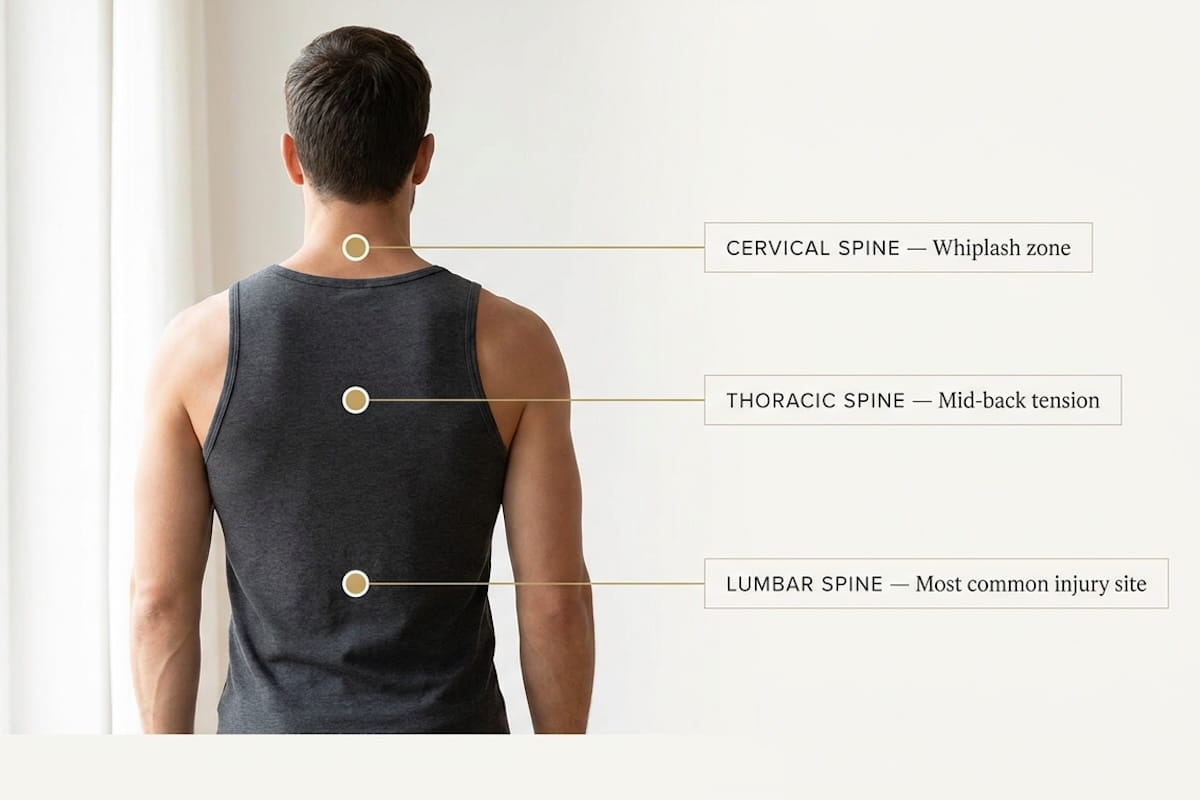
You walked away from the crash. Maybe a little sore. Maybe a little shaken. Now it’s two days later, and your neck is locked up, your head won’t stop pounding, or your lower back feels like someone parked a car on it.
This is not unusual.
Most people don’t feel how badly they’re hurt at the scene. During the collision, your body floods with adrenaline and endorphins that block pain signals from reaching your brain. That’s why people stand at the side of the road telling officers they’re fine when tissue is already torn, ligaments are stretched, and discs may be compressed.
Once the threat passes, those chemicals fade. Inflammation, which started building at impact, peaks 24 to 72 hours later. That’s why day three is often worse than day one. It’s also why the most common search a person makes after a car crash isn’t done at the scene. It’s done from bed three mornings later.
핵심 요약
- Adrenaline and endorphins released during a crash can mask serious injuries for hours or days. Feeling fine at the scene means nothing about how badly you’re hurt.
- Inflammation from soft tissue damage typically peaks 24 to 72 hours after impact, which is why pain often shows up on day two or three.
- Some symptoms require immediate ER attention: loss of bladder or bowel control, weakness on one side, worsening confusion, repeated vomiting, severe abdominal pain, or sudden hearing loss.
- Beyond the obvious neck, back, and head injuries, car accidents commonly cause TMJ damage, rotator cuff tears, vertigo, tinnitus, and seatbelt-related abdominal injuries that get missed at urgent care.
- California gives you two years to file a personal injury claim under CCP § 335.1, but every day you wait to document your injuries makes them harder to prove.
When to Worry: The Pain Cheat Sheet
Symptoms that mean you should go to the ER right now:
| Symptom | What it could be |
|---|---|
| Loss of bladder or bowel control, numbness in the groin or inner thighs | Cauda equina syndrome (surgical emergency) |
| Worsening headache, repeated vomiting, confusion, slurred speech | Brain bleed, subdural hematoma, cerebral edema |
| One-sided weakness, numbness, or coordination loss | Spinal cord compression or stroke |
| Severe abdominal pain, distention, or bruising along the seatbelt line | Internal bleeding, organ damage |
| Chest pain, shortness of breath, and coughing up blood | Rib fracture, collapsed lung, cardiac injury |
| Sudden hearing loss or vertigo with vomiting | Inner ear trauma, vestibular damage |
Pain by region: where to go and what to read next:
| Where it hurts | Likely cause | Who to see | Resource |
|---|---|---|---|
| Neck stiffness, shoulder pain, headache at base of skull | Whiplash, cervical disc, facet joint | Urgent care or PCP* within 72 hours | Neck stiffness days after a car accident |
| Lower or mid back, radiating into the legs | Lumbar strain, herniated disc, sciatica | Urgent care or PCP within 72 hours | Back pain days after a car accident |
| Head pressure, light sensitivity, brain fog | Concussion, post-traumatic headache | PCP within 72 hours; ER if worsening | Headaches days after a car accident |
| Jaw clicking, locked jaw, pain when chewing | TMJ disorder | Dentist or oral surgeon | Read below |
| Dizziness, room spinning when you turn your head | Post-traumatic BPPV | PCP, then ENT or vestibular PT | Read below |
| Ringing in the ears, ear fullness, hearing loss | Airbag acoustic trauma | ENT or audiologist | See below |
* PCP: personal care provider
The Pain Timeline: What to Expect
Different injuries peak at different times. Roughly:
Hours 0 to 24. Adrenaline and endorphins are still circulating. Most people feel shaken but not severely hurt. This is also when the most dangerous internal injuries can start, including intra-abdominal bleeding from seatbelt syndrome and brain bleeds, and they may not look bad until they suddenly do.
Days 1 to 3. Inflammation peaks. Soft tissue swelling sets in. This is when most people first notice neck stiffness, back pain, headaches, and chest soreness. If you’re going to feel whiplash, it usually arrives now. Pain that wasn’t there at the scene is not suspicious. It’s biologically predictable.
Days 4 to 7. Stiffness often gets worse before it gets better. Cervicogenic headaches from whiplash often appear here. Jaw pain from airbag deployment or whiplash hyperextension may start. Tinnitus from airbag noise may become persistent. PTSD symptoms (nightmares, hypervigilance, intrusive memories) typically begin in this window.
Weeks 2 to 4. Acute soft tissue inflammation begins to resolve. If your pain is getting worse instead of better, something else is going on. Subdural hematomas can present symptoms 2 to 3 weeks after the injury. Untreated disc injuries may start producing radiating pain down a leg or arm.
Months 1 to 3. Pain that persists past three months gets reclassified as chronic. About half of whiplash patients still have symptoms at twelve months. The earlier you document and treat, the better the outcome.
Months 3 and beyond. Chronic pain is now your problem to manage long-term. Whether you’ve been compensated for it depends largely on what you did in months one and two.
Pain Types That Often Get Missed
Rotator cuff and shoulder injuries. The seatbelt that prevents ejection delivers concentrated force across one shoulder. Combined with instinctive bracing on the wheel, the rotator cuff gets loaded in a position it can’t handle. Partial and full-thickness tears get missed at urgent care because they present as “general shoulder pain.” An MRI weeks later catches what an X-ray won’t.
TMJ and jaw pain. Whiplash can disrupt the TMJ disc and ligaments without any direct blow to the face. Airbag deployment adds direct impact. Roughly 23 percent of whiplash patients develop temporomandibular disorders, and symptoms often appear days or weeks later. Jaw clicking, headaches, pain when chewing, and ear pressure are common. A dentist or oral surgeon, not a regular PCP, is the right call.
Chest wall pain and seatbelt syndrome. That diagonal bruise across your chest from the shoulder belt is called the seatbelt sign. The deeper injury can include sternum bruising, rib fractures, costochondritis, and pneumothorax. A sharp pain on inspiration two days after the crash is not “just sore muscles.” Get it imaged.
Abdominal injuries. Lap belt forces concentrate on soft organs. A 2023 meta-analysis found that when an abdominal seatbelt sign is present, 42 percent of patients have an intra-abdominal injury, including damage to the liver, spleen, small bowel, or mesentery. These can present hours later with delayed peritonitis. Persistent abdominal pain, bruising along the belt line, distention, or fever needs a CT, not wait-and-see.
Vertigo and BPPV. Benign paroxysmal positional vertigo causes the room to spin when you turn your head, lie down, or roll over. Recent research confirms it’s more stubborn after trauma than the idiopathic version. If you’re getting dizzy when you turn your head, and the doctor didn’t think to check for this, ask.
Tinnitus and ear pain from airbag deployment. Airbags generate sound pressure peaks above 170 decibels inside the closed cabin. One review of patients with airbag-related ear injuries found 85 percent had hearing loss and 85 percent had tinnitus, with half experiencing ongoing balance problems. Ringing in your ears after airbag deployment is not a coincidence. See an audiologist.
PTSD that shows up as physical pain. PTSD doesn’t just look like flashbacks and avoidance. It also shows up as sleep disruption, headaches, GI problems, and amplified perception of all your other injuries. One prospective study of severe MVC survivors found 27.5 percent met PTSD criteria at six months. If your physical pain feels disproportionate to what your imaging shows, this might be why.
Knee, ankle, hand, and wrist injuries. Dashboard knee impacts, PCL tears, ankle injuries from braking, and wrist sprains from steering wheel bracing get underdiagnosed because the obvious injuries take precedence in the first 48 hours. If a joint hurts a week later and you didn’t mention it at the ER, mention it now.
What Adjusters Argue vs. What’s Medically True
Insurance adjusters work from a script. The script assumes that if you were really hurt, you’d have known immediately and sought treatment that day. The medical literature says the opposite.
| What the adjuster will argue | What the science actually says |
|---|---|
| “You said you felt fine at the scene” | Adrenaline and endorphins suppress pain perception during and immediately after trauma. Most people feel fine for hours. |
| “If it were serious, you’d have gone to the ER” | Inflammation peaks at 24 to 72 hours. Most soft tissue injuries don’t reach maximum pain until day two or three. |
| “You waited a week to see a doctor” | Several MVC injuries (subdural hematoma, TMD, post-traumatic BPPV) have documented delayed presentations measured in days to weeks. |
| “Your MRI is clean, so you’re not injured” | Many soft tissue and ligament injuries, including facet joint damage and grade I or II strains, don’t show on standard imaging. |
| “You posted a photo smiling at dinner” | Pain fluctuates throughout the day. A single moment doesn’t reflect overall function. |
None of this means you should wait to see a doctor. It means the adjuster’s framing of why you waited has nothing to do with whether you’re actually hurt. Document your symptoms from day one. Get evaluated within 72 hours. Keep going to follow-ups. The paper trail is what protects you.
What California Law Says About Delayed Pain Claims
California gives you two years from the date of the accident to file a personal injury lawsuit. The detail underneath the headline matters more.
The delayed discovery rule can extend that deadline when symptoms genuinely don’t appear until later, but you have to document when they actually started. A pain journal, dated daily entries, and prompt medical visits are what make that doctrine usable. Without documentation, you’re arguing it from memory.
California uses pure comparative negligence under Li v. Yellow Cab Co. You can recover damages even if you’re 99 percent at fault, with your award reduced by your share of responsibility. Texas bars recovery if you’re more than 50 percent at fault. Florida moved to modified comparative negligence in 2023. California is among the most plaintiff-friendly states in the country on this point.
Whether you need a lawyer depends on injury severity and how the adjuster is acting. For minor soft tissue injuries that resolve in weeks, you may not. For anything involving imaging, surgery, ongoing PT, lost wages, or a difficult adjuster, you probably do. Insurance Research Council data found that represented claimants receive settlements about 3.5 times larger than those of unrepresented claimants, even after attorney fees.
A lawyer’s actual job in a pain case looks less dramatic than TV makes it. It’s getting your medical records sequenced. It’s negotiating down medical liens that would otherwise eat your settlement. It’s handling the letters from adjusters you shouldn’t be answering yourself.
What Doctors Typically Recommend
DK Law isn’t a medical practice and won’t tell you how to treat your injuries. But the general standard of care after a soft tissue injury looks roughly like this:
Most acute soft tissue injuries respond to the RICE protocol (rest, ice, compression, elevation) for the first 48 to 72 hours, with heat appropriate later for muscle spasm. Physical therapy started in the sub-acute phase has strong evidence for whiplash and concussion recovery. Imaging gets ordered when symptoms warrant it (X-ray for fractures, CT for head trauma or suspected internal injury, MRI for persistent radicular pain), not as a baseline.
What to Do Next
If you’re in California and dealing with pain that started after a car accident, here’s the order of operations:
- If you have any of the red-flag symptoms in the first table, go to an emergency room now.
- If you haven’t been evaluated and it’s been less than 72 hours, see a PCP or urgent care today.
- Start a daily pain journal. Date every entry. Rate pain 0 to 10. Note what makes it worse.
- Don’t give a recorded statement to the other driver’s insurance company before talking to a lawyer.
- If your injuries are serious or the adjuster is being difficult, contact DK Law for a free consultation. California’s two-year filing deadline is firm, but the documentation you need starts now.
DK All the way


사고 직후부터 보상까지 all the way 함께
상담 예약
1:1 맞춤 한국어 상담 무료로 진행하기
DK Law에서 함께 합니다.
DK all the way
지금 바로 교통사고 전문 변호사와 무료 상담을 받아 보세요!

교통사고 보상, 시간이 관건입니다!
사고 후 대처가 빠를수록, 교통사고 보상 더 잘 받을 수 있습니다. 사고의 초기 대응이 증거 보존 및 피해자 권리 보호에 큰 도움이 됩니다.
승소하지 않으면 변호사 선임료 $0 | 24시간 상담 가능