


Irvine Local Insider
With top-ranked schools, a master-planned village system, and a composite safety score of 71.0, Irvine ranks among Southern California’s safest and most sought-after communities.
DK Law Safe Score Index: Irvine
Irvine has the lowest crash rate of all 21 cities in the DK Law Service Area Traffic Safety Index: 1.99 fatal or injury victims per 1,000 residents, based on pooled data from three years of California OTS data (2021–2023).
That earns a perfect Crash Rate Score of 100.0 and places Irvine at #4 out of 21 overall in Tier 1 (Safest), with a composite score of 71.0. The component holding the composite down is the Vulnerable Road User Score (34.5): pedestrians and bicyclists make up 16.7% of Irvine’s crash victims, a high share for a city with this little overall crash exposure.
Irvine Traffic Safety Snapshot
A closer look at 2023 collision data and statewide rankings across key safety categories.
TRAFFIC SAFETY OVERVIEW
570 total traffic victims
Ranked 2nd safest of 15 cities
California OTS ranked Irvine 14th of 15 comparable large cities for total fatal and injury victims in 2023, where #1 is worst. Among its peer group, only one city recorded fewer victims per its ranking.
pedestrian safety
37 PEDESTRIAN accident victims
Ranked safest of 15 cities
Irvine ranked 15/15 for pedestrians killed and injured, the best in its peer group. Wide setbacks and separated paths keep walkers away from traffic in most villages.
alcohol-involved crashes
55 fatal and injury victims
Ranked safest of 15 cities
Irvine ranked 15/15 for victims of alcohol-involved crashes, the lowest in its peer group. A limited bar scene and early closing hours are reflected directly in the crash data.
Cyclist SAFETY
24 child bicyclist fatalities
Ranked WORST of 15 cities
The exception in Irvine’s safety record. Riders under 15 killed or injured ranked 1st of 15 peer cities in 2023, the worst in the group, and ranked 1st of 15 in 2022 as well. The rise of e-bikes among middle and high school students is the pattern behind the number.
hit-and-run CRASHES
16 hit-and-run crashes
Ranked safest of 15 cities
Irvine recorded 16 fatal and injury hit-and-run collisions in 2023, ranking 15/15, the fewest in its peer group.
nighttime crashes
47 fatal and injury collisions
Ranked safest of 15 cities
Irvine ranked 15/15 for nighttime crashes (9:00 PM to 2:59 AM), the category most closely tied to impaired and fatigued driving statewide.
Source: California Office of Traffic Safety, Irvine 2023 City Rankings
Irvine is what happens when one company designs an entire city and never stops managing it: the safest big city in America, the best crash numbers in Orange County, and a place locals describe, with equal parts affection and exhaustion, as sixteen shades of beige.
Irvine at a Glance
No city in Southern California divides opinion along such a clean line. The people who love Irvine love it for exactly the reasons other people can’t stand it.
The numbers first. Irvine’s population sits around 321,138, after growing 44.8% between 2010 and 2020, one of the fastest growth rates of any large American city. Median household income is $136,719. The median age is 34. Nearly 40% of residents are foreign-born, and 70.6% of adults hold a bachelor’s degree or higher.
Asian Americans make up 42.9% of the city, the largest demographic group, spanning Chinese, Korean, Indian, Vietnamese, Filipino, Japanese, and Taiwanese communities. Irvine is also home to one of the largest Iranian American populations in the country, about 4.8% of residents.
The whole city was master-planned by the Irvine Company, the private firm that developed the 93,000-acre Irvine Ranch and, under billionaire Donald Bren, still owns a huge share of the city’s apartments, office parks, and shopping centers. Residents live in “villages,” not neighborhoods, each built around its own shopping center, parks, and schools, all governed by HOAs that regulate paint colors down to the approved earth-tone palette.
Irvine tends to suit families prioritizing schools and safety, professionals working at the Spectrum or Irvine Business Complex, and residents who prefer predictable, consistently managed infrastructure and services. It tends to be a less natural fit for those seeking an active nightlife scene, a traditional organic downtown, or fewer restrictions from HOA and community design guidelines.
Irvine Highlights
- America’s Safest Big City, 18 Years Running — Irvine has recorded the lowest violent crime rate of any U.S. city over 250,000 residents for 18 consecutive years, based on FBI crime data as reported by the city. Property crime, mostly package theft and vehicle break-ins, is the type of crime residents are most likely to experience directly.
- Best Crash Numbers in Its Class, With One Exception — Irvine ranked at or near the safest in nearly every California OTS category in 2023. The exception: children under 15 on bicycles, in which Irvine ranked worst in its 15-city peer group for two years in a row.
- The Two-Tax-Bill City — Newer villages carry Mello-Roos assessments of $5,000 to $12,000+ per year on top of regular property taxes, and the Great Park’s special tax never sunsets. Buyers who skip this line item get the surprise of their lives at the first tax bill.
- One Landlord to Rule Them All — The Irvine Company owns over 100 apartment communities in the city. Renters describe annual increases of 5 to 15% with no negotiation, and many newer buildings are exempt from California’s rent caps.
Is Irvine Safe?
네 맞습니다. On crime, Irvine’s record is close to unmatched among large American cities. The city has had the lowest violent crime rate among U.S. cities with over 250,000 residents for 18 consecutive years, based on FBI data. The crime that actually reaches residents is property crime: parcel theft, vehicle break-ins in apartment parking structures, catalytic converter theft, and organized burglary crews that target luxury homes near open-space preserves, working predictable patterns when owners travel. Residents on r/irvine trade camera footage and burglary-ring warnings the way other cities’ subreddits trade violent crime alerts. It’s a meaningfully different tier of problem.
The traffic story is nearly as good. Wide arterials with 45 to 55 mph limits usually produce ugly crash data, and Irvine’s roads do encourage speed. But the 2023 OTS numbers rank Irvine safest or second-safest in its 15-city peer group for total victims, pedestrians, alcohol-involved crashes, nighttime crashes, and hit-and-runs.
One category breaks the pattern. Irvine ranked worst in its peer group for bicyclists under 15, with 24 children killed or injured in 2023. It ranked worst in that category in 2022 too, with 29. This is the e-bike era arriving in a city where middle and high schoolers ride to school along 50 mph arterials, and where neighborhood bike paths cross those arterials at speed. For a city that wins every other safety category, being the most dangerous in its class for kids on bikes is the single most important safety fact a parent moving here should know.
The locations residents flag most often: Culver Drive at Bryan Avenue near Beckman High School (left-turn collisions and red-light running), Culver at Walnut, Harvard Avenue at Barranca Parkway, Campus Drive at California Avenue near UCI (car, pedestrian, and e-bike conflicts), and the merging chaos of the El Toro Y, where the 5 and 405 converge. These come from resident reports and local coverage rather than a published city high-injury network, so treat them as where the friction is felt, not a formal ranking.
DK Law represents Irvine families in bicycle, e-bike, and pedestrian injury cases, and the school-commute corridors above are where that work concentrates. The firm’s Irvine office sees the gap between the city’s reputation and the under-15 cyclist data up close.
Local’s Tip
“Fully agree with safe (besides on the wide roads and occasionally speeding e-bikes – maybe not city specific) and schools are good but I’m compelled to mention, certain schools/programs are hyper competitive.” –r/Irvine, Reddit.
Best Neighborhoods in Irvine (The Villages)
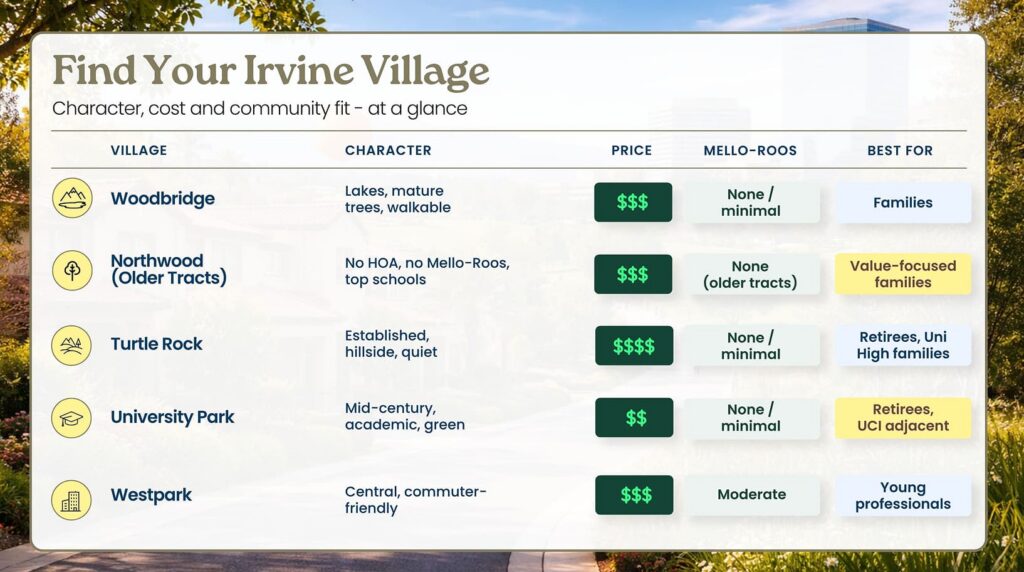
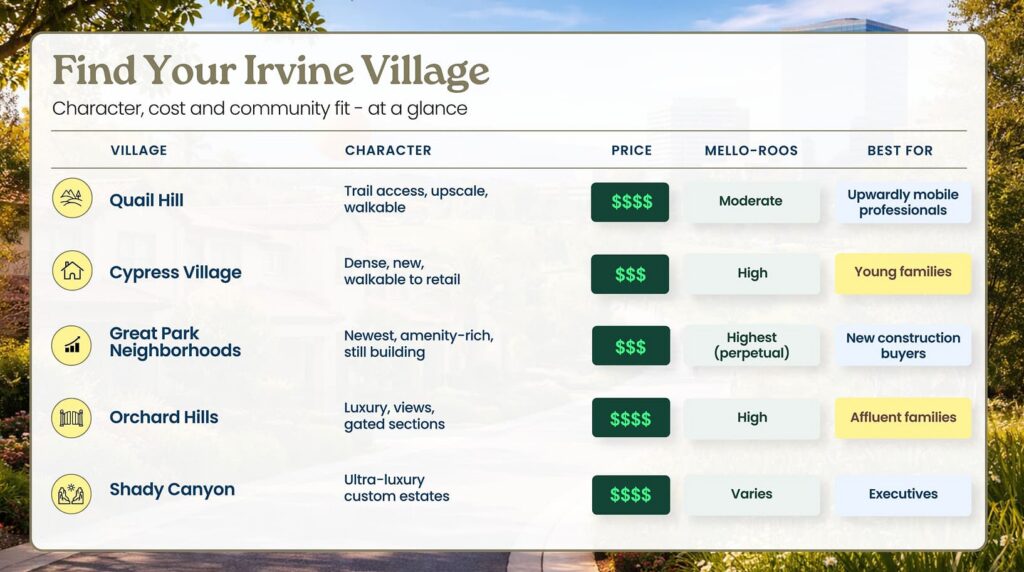
Irvine doesn’t have neighborhoods. It has villages, each master-planned around its own shopping center, schools, and parks, and the first thing any local asks is which one you’re in. The second thing they ask, if you bought recently, is what your Mello-Roos runs. The village determines both.
Woodbridge
The village other villages get measured against. Built in the late 1970s around two artificial lakes with landmark footbridges, Woodbridge has the mature trees, walkable loops, and lived-in feel that newer Irvine can’t manufacture. Homes run roughly $800K for older condos to $1.8M+ for detached houses, and the older housing stock means minimal Mello-Roos. Some interiors are dated. Residents consider that a fair trade.
Northwood
The value play, if that word applies anywhere in Irvine. The older Northwood tracts are the rare Irvine anomaly: no HOA, no Mello-Roos, and still feeding top-tier IUSD schools. Homes range from roughly $1.2M to $2.5M+. For buyers doing the full 30-year math on carrying costs, older Northwood often beats newer villages with lower sticker prices. Locals know this, which is why inventory moves fast.
Turtle Rock
Hillside, eucalyptus-lined, and quiet in a way that borders on hushed. Large single-family homes and estates from about $1.5M to $4M+, popular with retirees and with families targeting University High. Almost nothing is walkable. Nobody here seems to mind.
University Park
One of the oldest villages, adjacent to UCI, full of mid-century single-story homes and townhomes from roughly $750K to $1.5M. Greenbelts, libraries, an academic calm. Like Northwood, the older stock means the tax bill is what the county says it is, nothing bolted on.
Westpark
Late-80s Mediterranean stucco in the geographic center of the city, minutes from the 405. Townhomes and houses from about $700K to $1.8M. It’s the commuter village and one of the more walkable ones by Irvine standards (Walk Score: 54, the second-highest in the city). Not much character. Maximum convenience.
Quail Hill
Early-2000s and upscale, tucked into the southern foothills with direct trailhead access and a walkable shopping center. Townhomes around $1M, estates to $3.5M. The village for people who want to hike before work and be at the Spectrum in eight minutes.
Cypress Village
Dense, new, and built along the Jeffrey Open Space Trail with genuine walkability to retail and schools. Townhomes and homes from about $850K to $2M. Lots are compact, and neighbors are close. The trade-off is deliberate: you’re buying the village amenities, not a yard. Mello-Roos runs high here.
Great Park Neighborhoods
The newest and most complicated choice in the city, built on the former El Toro Marine Corps Air Station. Contemporary architecture, resort-style pools, new school campuses, and the Great Park itself as a front yard. Homes run from roughly $800K to $2.5M, and by price per square foot, they often look cheaper than the rest of Irvine.
The tax bill explains why. Great Park homes carry the city’s heaviest Mello-Roos assessments, with a 2% annual escalator, and the special tax does not sunset: after 40 years it converts to a permanent maintenance fee.
Notable Mentions
- Oak Creek – Gated convenience near the golf course, roughly $800K to $1.7M.
- Portola Springs – Northeastern foothills, resort-style pools, high Mello-Roos, still under construction.
- Orchard Hills – Luxury homes beside working avocado orchards. The neighboring asphalt plant residents fought for years was bought out by the city for roughly $134 million and is becoming a 700-acre preserve.
- Columbus Grove – Tustin-border value, with schools split between two districts. Check the boundary before you buy.
- Shady Canyon – $5M to $20M+ custom estates behind gates, for people who will never read this page.
Local’s Tip
“So, after 52 years of working and living in Irvine, I’d have to say I highly recommend it! Just keep your drama and complaints about living in a planned community with HOA regulations to yourself if you do move here. Irvine is nice and tidy for a reason.” –r/Irvine, Reddit.
Cost of Living & Affordability
Start with the number that isn’t on the listing. In Irvine’s newer villages, the property tax bill has two parts: the standard rate, then the Mello-Roos special assessment layered on top. Homes in neighborhoods built after Mello-Roos financing became standard typically carry a combined effective rate closer to 2% of the purchase price, rather than the 1% baseline rate often quoted.
Only older, established Irvine neighborhoods built before these assessments were common fall outside this structure. On a $1.4M home, that difference is roughly $14,000 a year, every year. No other line item separates Irvine’s villages more sharply, and no other Orange County city makes buyers do this math.
The baseline numbers as of early 2026:
- Median owner-occupied home value: $1,191,500 (Census ACS, 2020–2024); current market estimates run higher, in the $1.4M–$1.6M range for single-family homes (verify against live Zillow/Redfin before publish)
- Median gross rent: $2,997 (Census); market-rate 1BRs run roughly $2,600–$3,200, 2BRs $3,400–$4,500 depending on village
- Homeownership rate: 44.5%, with 55.5% renting
- Median household income: $136,719
The comparison set: Newport Beach is far more expensive (median above $3M), while Tustin and Lake Forest offer entry points around $900K to $1.2M, and Costa Mesa runs $1.1M to $1.3M with an older, unplanned housing stock that is either a downgrade or the entire point, depending on your taste. Irvine’s premium buys the schools and the planning. It does not buy relief. Renting means, more often than not, renting from the Irvine Company, which owns more than 100 apartment communities citywide.
Comfortable living here, by the standard rent-burden math, takes roughly $110K to $130K for renters and $250K+ for buyers of a median home. Irvine’s median income covers the first number. The second is why the homeownership rate sits under 45%.
Sources: City of Irvine, U.S. Census Bureau
“Good for settling down and raising kids ideally but very cookie cutter suburban city but with enough varied restaurants to enjoy and just enough entertainment to keep you up till 10pm so you can go home to your kids.”
육체적, 정신적 고통까지 – Reddit User
Getting Around: Traffic, Commute & Transit
The average Irvine resident commutes 24.7 minutes, which is short by Southern California standards and slightly misleading, because Irvine is the destination. As Orange County’s largest job center, the city’s daytime population swells with commuters flowing into the Irvine Business Complex and the Spectrum corporate parks. Residents commute against traffic or barely commute at all. Everyone else fights their way in.
Commuting Options at a Glance
| Mode | Route / Coverage | Pros | Cons | The Local Reality |
|---|---|---|---|---|
| Freeway | I-5, I-405, SR-133, SR-241, SR-73 | Direct access in every direction | The El Toro Y (5/405 convergence) bottlenecks both rush hours | Morning northbound and evening southbound at the Y are the fixed points around which South OC commutes are planned. |
| Metrolink | Irvine Station (Spectrum area), OC Line + IE-OC Line | Reliable rail to LA, Riverside, San Diego connections | Last-mile gap outside the Spectrum area | The iShuttle bridges the station to IBC and Spectrum office parks. For that specific commute, it genuinely works. |
| OCTA Bus | ~18 bus lines, 2 rail lines | Affordable, covers the flat core | Slow; thin coverage in newer villages | Functional for UCI students and service workers. Not a car replacement. |
| Cycling | 113 miles of off-street trails, 286 miles of bike lanes | One of the most extensive networks in California; Jeffrey Open Space and San Diego Creek trails cross the whole city | Arterial crossings are the danger points, especially for kids | The network is real. So is the under-15 cyclist injury ranking. The trails are safe; the intersections where trails meet 50 mph arterials are not. |
| Walking | Village cores only | Village centers put groceries within a walk | Walk Score 43 citywide; car-dependent between villages | You walk within your village. You drive between them. That’s the design working as intended. |
Walkability & Transit Scores
Irvine scores as car-dependent overall, which is the master plan working exactly as designed: errands are walkable within your village, and nothing is walkable between villages.
- Walk Score: 43 citywide. The most walkable pockets cluster around the older central villages: University Town Center ranks highest, with Westpark second at 54. The newer villages score well below the citywide number despite their internal paths, because the paths lead to the village center and stop.
- Transit: roughly 18 OCTA bus lines plus Metrolink rail serve the city, with coverage concentrated around UCI, the Irvine Business Complex, and the Spectrum. Newer villages in the north and east see thin service.
- Cycling: 113 miles of off-street trails and 286 miles of on-street lanes, one of the most extensive municipal networks in California. The Jeffrey Open Space and San Diego Creek trails cross the entire city. Score one for the master plan; see the safety section for the asterisk about where trails meet arterials.
Source: Walk Score, Irvine, CA
Where Commuters Hit Friction
The El Toro Y is the headline: the 5 and 405 converge in southern Irvine, and the merge produces the rapid lane changes and rear-end patterns that come with any major interchange. On surface streets, Jamboree Road, Culver Drive, Barranca Parkway, and Alton Parkway stack up near freeway ramps and office parks from 7 to 9 AM and 4:30 to 6:30 PM.
Parking is a non-issue in residential Irvine and a blood sport at the destinations: the Diamond Jamboree structure at lunch, the Spectrum on weekend evenings, and UCI, where permit pricing is engineered to make you take the shuttle.
The commuter-hour conflict points overlap with the safety section’s list: Culver at Bryan, Harvard at Barranca, Campus at California. Wide, fast arterials meeting school and university traffic. DK Law’s car accident 그리고 bicycle accident work in Irvine concentrates along exactly these corridors.
Things to Do, Food & Lifestyle
Any account of eating in Irvine starts at a strip mall, because the city’s best food lives in plazas, not on a restaurant row. The scene runs on the Pacific Rim and Persian communities that call Irvine home, and locals treat their rankings, especially the boba rankings, as a contact sport. The student newspaper at Portola High publishes boba reviews. That detail tells you most of what you need to know about this city.
Some spots worth knowing:
- Diamond Jamboree – Alton Pkwy & Jamboree Rd. The densest concentration of Pacific Rim food in Orange County. Meet Fresh opened its first U.S. location here to 20-minute lines, Korean street-food chain Young Dabang chose it for its first American outpost, and 85°C Bakery still has a line years after opening. Tim Ho Wan, famous as the cheapest Michelin-starred restaurant in the world, reopened here in late 2025 after a long renovation. The parking structure is notorious. Locals consider circling it part of the price of admission.
- BCD Tofu House – Diamond Jamboree. Bubbling soft tofu stew served late into the night, in a city where almost nothing else stays open. The de facto after-hours option for the entire east side.
- OMOMO Tea Shoppe – Culver Dr. Rope stanchions at night, at a boba shop. Irvine may be the boba capital of America, and OMOMO is where the argument usually starts. 7 Leaves wins on tea quality and loses on parking; The Alley, Sunright, Mixue, and a new opening roughly every quarter keep it going. TeaByDo stays open until 1 AM, which in Irvine qualifies as nightlife.
- Wholesome Choice – Culver Dr. Persian supermarket with a hot food court and fresh flatbread coming off the line all day. The anchor of the Iranian community’s food axis, and a lunch destination that draws from across the county.
- Caspian Restaurant – Michelson Dr. Persian fine dining institution: kabobs, stews, and weekend banquets. Where Irvine’s Iranian community celebrates, which is the strongest endorsement a restaurant can have.
Local’s Tip
“I moved here from a larger city on the east coast. Irvine is definitely cleaner, safer, and has excellent Asian food that’s authentic and plentiful. The food is the best part of living here.” –r/Irvine, Reddit.
Beyond food: the Great Park is mid-transformation from punchline to centerpiece. For two decades, the former El Toro Marine base was better known for audits and delays than amenities. Now the sports complex and Great Park Ice (the Anaheim Ducks’ practice facility) are built and busy, the orange balloon went back up in May 2026 with a new envelope, the Sunday farmers market runs year-round (temporarily relocated to Stonegate Elementary during construction), and a $1B+ buildout phase broke ground covering lakes, a botanic garden, museums, and a permanent 10,000-seat amphitheater targeting 2027, replacing the temporary Great Park Live venue. The Irvine Spectrum, meanwhile, is installing a new 132-foot Ferris wheel debuting in summer 2026, built in Italy and shipped through the Panama Canal.
Nightlife: functionally, there isn’t any. Most restaurants close by 9 or 10 PM, parks close at dusk, and zoning has kept standalone bars and venues to a minimum. Residents who want a night out drive to Costa Mesa or the Newport peninsula and drive home to a city that’s already asleep. A local Saturday looks like the Jeffrey Trail or Quail Hill loop in the morning, the farmers market or an international grocery run midday, a community pool afternoon, and a plaza dinner or Spectrum movie at night.
Schools & Family Life
IUSD: The Reason Half the Buyers Are Here
부당 사망 클레임을 제기할 수 있는 Irvine Unified School District ranks among the top districts in California, with roughly 74% of students meeting or exceeding state standards in English and over 70% in math – nearly double the statewide math rate, and well above the statewide English rate as well.
Within the district, parents maintain an unofficial high school hierarchy that shapes home purchases. Homes inside the University High and Northwood boundaries reportedly carry a 5 to 15% premium over comparable homes elsewhere in the district, and proposed boundary changes trigger the fiercest community fights in the city.
Schools Families Try Hardest to Get Into
| School | Grades | Reputation | What Parents Say |
|---|---|---|---|
| University High (“Uni”) | 9–12 | The flagship | The district’s oldest campus and its most competitive, sitting beside the UCI campus with the strongest STEM pipeline in Irvine. Families move across the city just to land in this boundary. |
| Northwood High | 9–12 | The close second | Nearly Uni-level academics with a reputation for being slightly more collaborative than cutthroat. Standout music program. |
| Portola High | 9–12 | The rising newcomer | The newest campus, state-of-the-art facilities, results climbing year over year. Serves the Great Park growth area. |
| Woodbridge High | 9–12 | The balanced pick | Strong academics without the sharpest edge of the pressure culture. The traditional, well-rounded experience. |
| Irvine High | 9–12 | The original | One of the district’s original campuses, opened in 1974. Excellent by any normal standard – it’s only Irvine’s own curve that makes it look modest by comparison. |
The Private School Question
Families paying seven figures partly for IUSD access still shop private, and the two most common reasons are religious curriculum and escaping the exact pressure culture described above. Tarbut V’Torah, the Jewish community day school, runs roughly $45,000 to $47,000 a year for upper-school students. Crean Lutheran, near the Great Park, runs about $18,000 to $24,000. Smaller classes and a lower-stakes environment are the recurring justifications from parents who could have had the famous public schools for free.
Family Practicalities
Every village was designed around parks, pools, and youth sports infrastructure, and it shows: the family amenity layer is the best-executed part of the master plan. Childcare cost data specific to Irvine is thin; Orange County center-based infant care runs around $22,000+ per year countywide, and Irvine skews above county averages for most services.
Senior Living
For families weighing a move for aging parents, Irvine has a substantial senior living market: independent living communities run roughly $3,500 to $5,500 per month, with assisted living and memory care at facilities like Regents Point, Atria Park of Woodbridge, and Woodbridge Terrace ranging from $5,500 to $9,500+ depending on care level. Waitlists at the popular facilities run months, not years, a better picture than neighboring cities.
Moving to Irvine: What to Know
City services:
- City Hall: 1 Civic Center Plaza, Irvine, CA 92606. (949) 724-6000. Mon–Thu 7:30 AM–5:30 PM, Fri 8 AM–5 PM
- Police non-emergency: (949) 724-7000
- Irvine Public Library – Heritage Park: 14361 Yale Ave
- Metrolink Irvine Station: Spectrum area, with iShuttle connections to business parks
Hospitals:
- Hoag Hospital Irvine: 16200 Sand Canyon Ave
- Kaiser Permanente Irvine Medical Center: 6640 Alton Pkwy
- UCI Health – Irvine: 19210 Jamboree Road
Utilities:
- Electric: Southern California Edison
- Gas: SoCalGas
- Water: Irvine Ranch Water District: (949) 453-5300. IRWD’s tiered budget-based billing is unusual; going over your water budget gets expensive fast
- Internet: Cox and AT&T Fiber serve most of the city
Two things to know before you sign anything. If you’re renting, check the building’s age: complexes under 15 years old are exempt from California’s AB 1482 rent caps, and much of Irvine’s rental stock qualifies, which is how double-digit renewal increases happen legally. If you’re buying, pull the full tax bill for the specific address from the OC Treasurer’s site before you fall in love. The Mello-Roos line varies from zero to five figures between villages, and in the Great Park it never expires.
If you’re injured in a crash on Irvine’s roads, whether at the El Toro Y, along the Culver or Jamboree corridors, or in one of the school-zone bike conflicts this city sees too many of, DK Law has represented Irvine and Orange County residents in 자동차 사고, 자전거 사고및 pedestrian injury cases for years.
Irvine By The Numbers
Discover what makes Irvine stand out — a master-planned city with top-ranked schools and one of the safest safety scores in Southern California.
318K+
Residents
One of the fastest-growing large cities in America: 44.8% population growth between 2010 and 2020, on track toward a master-planned buildout well above today’s count.
1971
Year Incorporated
Incorporated in 1971 on land carved from the 93,000-acre Irvine Ranch. The Irvine Company designed the city before it existed and still owns much of it.
$136K+
Median Household Income
Median household income of $136,719, among the highest of any large U.S. city, against a median owner-occupied home value of $1.19M and market prices well above it.
34
Median Age
A young city by affluent-suburb standards, pulled down by UCI’s roughly 37,000 students and up by the families the school district attracts.
내게 필요한 정보 찾기
가까운 지점 정보, 교통사고 대처 상식, 상해 종류 별 정보 등 교통사고 관련 모든 정보를 한 곳에 모았습니다.
내 주변 지점 찾기
가까운 DK Law 지점을 찾아보세요.

DK Law 전문 분야 찾기
교통사고부터 사망사고까지, DK Law의 주요 전문 분야를 확인해보세요.

DK All the way


사고 직후부터 보상까지 all the way 함께
상담 예약
1:1 맞춤 한국어 상담 무료로 진행하기
Were you injured in an accident in Irvine?
We Can Help You. Call Us For a Free Consultation Today.
DK Law에서 함께 합니다.
DK all the way
지금 바로 교통사고 전문 변호사와 무료 상담을 받아 보세요!

교통사고 보상, 시간이 관건입니다!
사고 후 대처가 빠를수록, 교통사고 보상 더 잘 받을 수 있습니다. 사고의 초기 대응이 증거 보존 및 피해자 권리 보호에 큰 도움이 됩니다.
승소하지 않으면 변호사 선임료 $0 | 24시간 상담 가능