


Do I Really Need a Personal Injury Lawyer in California?
Find out in a minute whether you need a lawyer for your California injury claim. Take the self-assessment below.
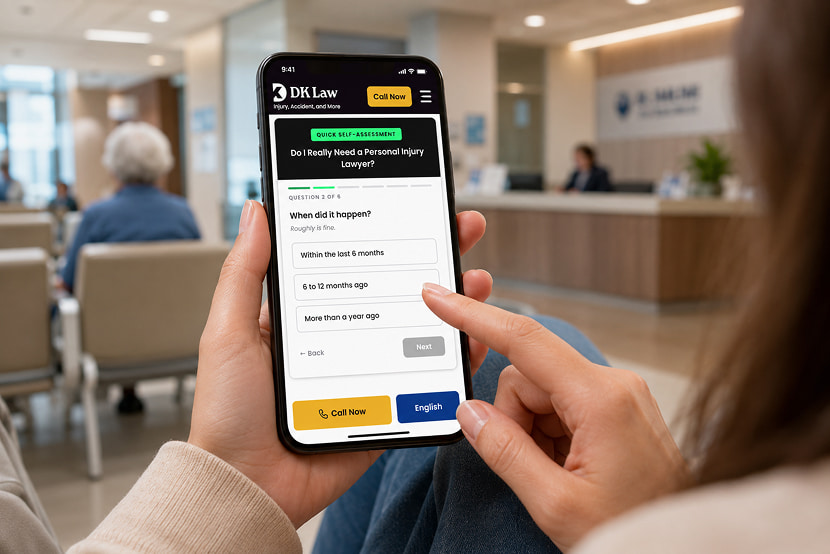
The honest answer is: Not always. That’s the honest starting point, and it’s the answer most law firm websites won’t give you.
Some injuries are minor, fault is obvious, the insurance company pays what it should, and hiring an attorney would just hand a third of your money to someone you didn’t need. Other situations look simple on day one and turn out to be the kind where going it alone costs you far more than a lawyer ever would. The problem is telling them apart from the inside, while you’re sore, annoyed, and getting calls from an adjuster.
The quickest way to find out which situation you’re in: answer the six questions below. It takes about a minute, and it will tell you no if the answer is no.
What this means
A sensible next step
One thing that can’t wait: because a government entity or public property may be involved, your claim could run on a much shorter timeline than the standard 2 years. In many cases a formal claim must be filed within 6 months. Whatever you decide about hiring a lawyer, get clarity on your deadline soon.
About your timeline: you said this happened more than a year ago. California’s standard deadline for most injury claims is 2 years from the date of injury, and some deadlines are shorter. If you’re going to act, the window is already narrowing.
Before you talk to any insurance company: if an insurer has asked you for a recorded statement, or sent you anything to sign, hold off until you understand what it means. Recorded statements can be used to reduce your claim, and a signed release usually ends it permanently, including for injuries you haven’t discovered yet.
This tool provides general information only, not legal advice, and the result is not an evaluation of your specific case. Every situation is different, and prior results do not guarantee a similar outcome. For advice about your circumstances, speak with a licensed California attorney.
핵심 요약
- Many minor California injury claims can be handled without a lawyer, especially when nobody was seriously hurt, fault is undisputed, and total costs stay under a few thousand dollars.
- California small claims court handles disputes up to $12,500 and doesn’t allow attorneys at the hearing.
- The factors that genuinely call for a lawyer are a real injury, a dispute over fault, an insurer delaying or lowballing, high or still-growing costs, or a complicated party like a government entity or commercial vehicle.
- Personal injury attorneys in California work on contingency, and the fee is negotiable, not set by law. You pay nothing unless they recover money.
- The most expensive mistake isn’t hiring or not hiring a lawyer. It’s settling before you know what your injuries actually are.
The short answer
You likely don’t need a personal injury lawyer if all of these are true:
- Nobody was hurt beyond bumps and bruises that healed
- The other side clearly caused it and isn’t arguing otherwise
- The insurance company is responding and paying fairly
- And, your total costs are small
Handle it directly, and if the insurer won’t pay a fair amount on a small claim, the small claims court exists for exactly that.
You should talk to a lawyer if any of these are true:
- You’re injured and still being treated
- Someone is blaming you or disputing what happened
- The insurer is stalling or has made an offer that doesn’t cover your costs
- Your costs are high or still unknown
- Or, the situation involves a government entity, a commercial vehicle, an uninsured driver, or a death
Everything below unpacks the worries behind that answer, because they’re usually what people are actually asking.
Is this even serious enough to bother with?
This is the quiet question underneath most hesitation, and it cuts both ways.
Plenty of people overestimate. A scraped bumper and a stiff neck that’s gone by Friday is not a case that needs a legal team, and anyone who tells you otherwise is selling.
But more people underestimate, and they do it in a specific, predictable way: the lingering ache they’re ignoring. Soft-tissue injuries, the sore back, the neck that hasn’t loosened up, the headaches that started a few days later, are the most undercounted claims there are, because they don’t look like much at first, and they don’t show up on an X-ray.
If you have pain that’s persisting weeks after the incident, that’s not a “probably nothing.” See a doctor, get it documented, and don’t accept any settlement until you know what you’re dealing with. Once you sign, California releases typically waive even the injuries you haven’t discovered yet, and that’s permanent.
Can I just handle it myself?
Often, yes. Here’s what the do-it-yourself path realistically looks like, because it’s a legitimate option and you should know what you’re choosing.
You deal with the insurance company directly: report the claim, document everything, send them your bills and repair estimates, and negotiate. For a small, clean claim, this works fine. Insurers pay straightforward claims all the time. If they won’t pay fairly and the amount is under $12,500, the California small claims court is fast and cheap; filing costs run $30 to $100, you’ll usually get a hearing within a couple of months, and lawyers aren’t allowed at the hearing anyway, so the playing field is level.
The DIY path has two real risks. The first is undervaluing your own claim – almost everyone forgets future medical costs, lost earning capacity, and the non-economic side entirely. The second is the paperwork traps: giving a recorded statement to the other side’s insurer (you’re generally not required to), signing a broad medical authorization that lets them dig through your history, or accepting a fast offer before your treatment is done. If you handle it yourself, your job is mostly to avoid those three mistakes.
Are lawyers just going to tell me to hire them?
A fair suspicion. The economics actually answer it.
California personal injury lawyers work on contingency: typically around a third of the recovery before a lawsuit is filed, more if it goes into litigation, and nothing unless they win. That fee structure means a lawyer who takes your case is betting their own time that it’s worth something. It also means that on a genuinely small claim, the math doesn’t work for either of you, which is why an honest firm will tell some callers they don’t need one. The consultation itself is free, so the worst outcome of asking is a no that costs you nothing.
What it also means: don’t measure an offer or a fee in gross dollars. Measure your net. A lawyer is worth hiring when they change what you walk away with, after their fee, by more than they cost. In serious or disputed cases, that’s the norm. In trivial ones, it isn’t.
When legal representation is worth considering
Some facts take the decision out of the gray zone, whatever the rest of your answers look like.
A serious or permanent injury, or a death, means the stakes are too high to negotiate alone against professionals. A dispute over fault matters more in California than people expect, because your compensation drops by whatever percentage of blame lands on you, and shifting blame is the cheapest tool an insurer has. An at-fault driver with no insurance is common here – roughly 1 in 5 California drivers is uninsured, and recovering then means a claim against your own policy, which is its own negotiation. An injury at work layers workers’ compensation rules on top of everything else.
And if a government entity is anywhere in the picture, a city vehicle, a fall on public property, a dangerous road condition, move quickly regardless of what you decide about hiring anyone. Claims against California public entities generally require a formal claim within 6 months, not the 2 years people assume they have.
How to decide
Take the assessment above if you haven’t. If it says you probably don’t need a lawyer, believe it, handle the claim carefully, keep records, and come back if anything changes. If it says maybe or yes, the next step costs nothing: a free consultation where you find out whether representation would actually change your outcome.
Either way, don’t sign anything, accept any offer, or give a recorded statement until you’re sure which situation you’re in. Those are the steps you can’t take back.
If you’ve been injured anywhere in California and want a straight answer about where you stand, DK Law for a free consultation.
사고 순간부터 보상을 받는 날까지, 끝까지 함께 하겠습니다.
추가 비용 없이 상해 보험금 청구와 재산 피해 보상을 위해 싸우고 있습니다.
내게 필요한 정보 찾기
가까운 지점 정보, 교통사고 대처 상식, 상해 종류 별 정보 등 교통사고 관련 모든 정보를 한 곳에 모았습니다.
내 주변 지점 찾기
가까운 DK Law 지점을 찾아보세요.

DK Law 전문 분야 찾기
교통사고부터 사망사고까지, DK Law의 주요 전문 분야를 확인해보세요.

DK all the way
사고 직후부터 보상까지 all the way 함께
상담 예약
1:1 맞춤 한국어 상담 무료로 진행하기
DK Law에서 함께 합니다.
DK all the way
지금 바로 교통사고 전문 변호사와 무료 상담을 받아 보세요!

교통사고 보상, 시간이 관건입니다!
사고 후 대처가 빠를수록, 교통사고 보상 더 잘 받을 수 있습니다. 사고의 초기 대응이 증거 보존 및 피해자 권리 보호에 큰 도움이 됩니다.
승소하지 않으면 변호사 선임료 $0 | 24시간 상담 가능