Apartment Slip and Fall Settlements in California: What Your Case is Actually Worth
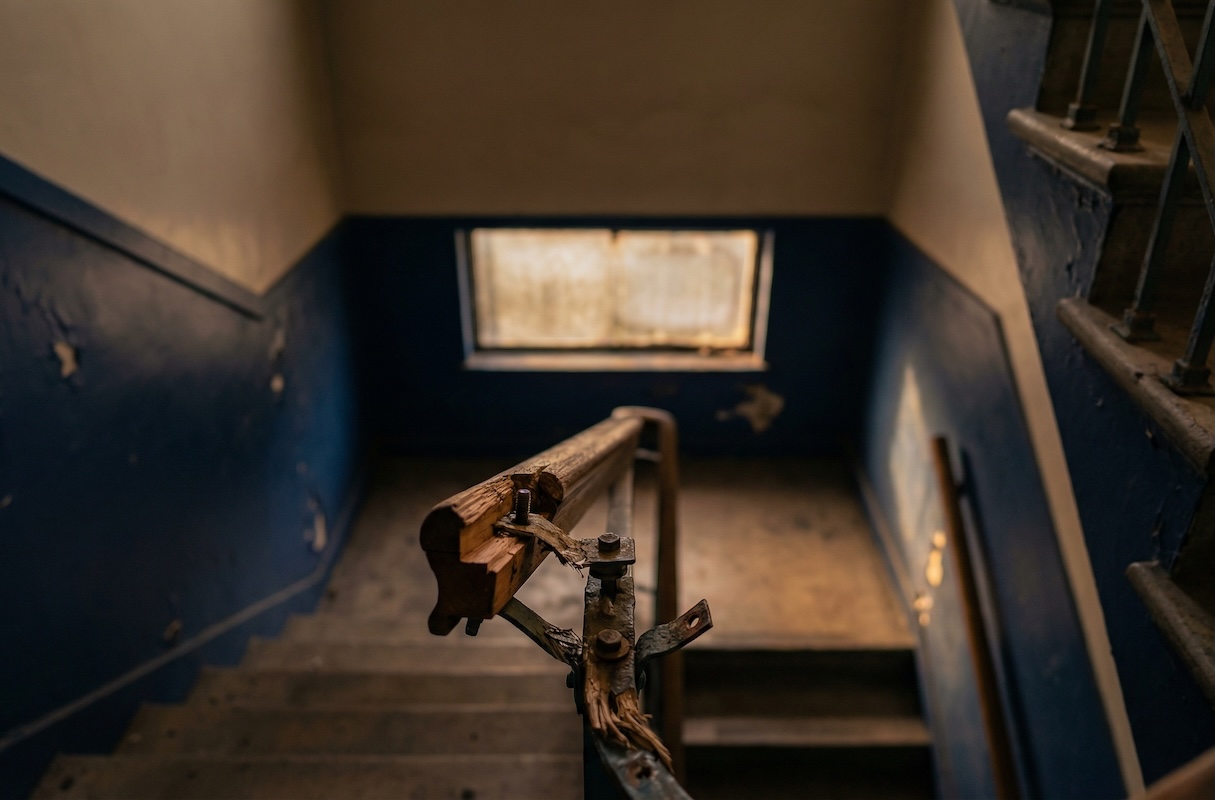
You slipped on your apartment stairs because the landlord never fixed the broken railing you complained about three times. Now you’re dealing with back pain, missed work, and an insurance adjuster who keeps calling with offers that feel way too low.
Sound familiar?
California law is actually pretty clear about these things. Landlords have to maintain safe premises. When they don’t, and you get hurt, they’re on the hook for your injuries. But here’s what most people don’t realize: apartment slip and fall cases come with their own set of rules and leverage points that can dramatically change what your settlement looks like.
핵심 요약
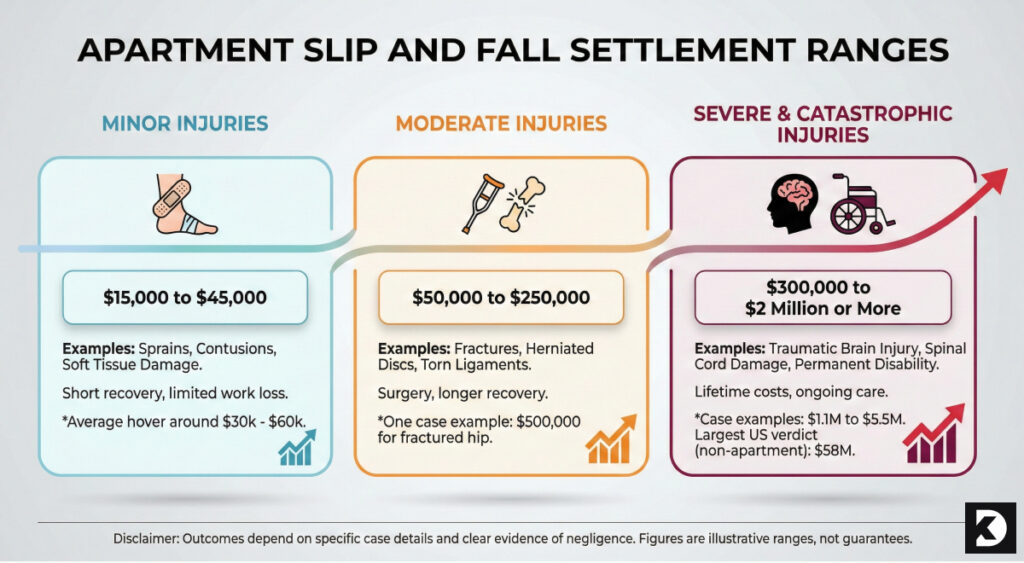
- Average settlements range widely: Minor injuries typically settle between $15,000 and $45,000, while moderate injuries like fractures or herniated discs fall in the $50,000 to $250,000 range. Severe injuries with permanent disability can reach $1 million or higher.
- California landlords can’t escape habitability requirements: Under Civil Code § 1941.1, landlords must maintain floors, stairways, and railings in good repair. These obligations cannot be waived, even in your lease agreement.
- Documentation before your injury is powerful: Maintenance requests you submitted before the accident prove the landlord knew about the hazard and did nothing. This “prior knowledge” is often the difference between a lowball offer and a serious settlement.
- California uses pure comparative fault: Even if you were 30% responsible for your accident, you can still recover 70% of your damages. You don’t lose everything just because you could have been more careful.
- Common areas drive most claims: Lobbies and stairwells account for about 40% of apartment slip and fall cases, with wet floors from leaks topping the list at 28%.
What Do Apartment Slip and Fall Cases Actually Settle For?
Let’s get specific. Because “it depends” isn’t helpful when you’re trying to figure out if your case is worth pursuing.
| Injury Category | Settlement Range | Typical Injuries | Key Context |
|---|---|---|---|
| Minor Injuries | $15,000 to $45,000 | Sprains, contusions, soft tissue damage | Short recovery (weeks). Can hit $60k if negligence is clear. |
| Moderate Injuries | $50,000 to $250,000 | Fractures, herniated discs, torn ligaments | Usually involves surgery. 6-12 months impact on life. |
| Severe & Catastrophic | $300,000 to $2 Million+ | TBI, spinal cord damage, permanent disability | Calculates lifetime care costs. Verdicts can exceed $5M. |
Minor Injuries: $15,000 to $45,000
We’re talking sprains, contusions, and minor soft tissue damage. The kind of injury where you miss a week or two of work, go to physical therapy a few times, and mostly recover within a couple of months. Average settlements in this range hover around $30,000 to $60,000, depending on how clear the landlord’s negligence was.
Moderate Injuries: $50,000 to $250,000
Fractures. Herniated discs. Torn ligaments that need surgery. These are the injuries that change your life for six months to a year, sometimes longer. A case involving spinal surgery after a fall can push settlements past $200,000, especially when there’s documented evidence that the landlord ignored the hazard.
One case saw a tenant receive $500,000 for a fractured hip from an apartment slip and fall. That’s not typical, but it shows what’s possible when injuries are serious, and liability is clear.
Severe and Catastrophic Injuries: $300,000 to $2 Million or More
Traumatic brain injuries. Spinal cord damage. Permanent disability. These cases take years to resolve because the lifetime costs are staggering. You’re calculating lost earning capacity, ongoing medical care, home modifications, and pain and suffering that never really ends.
The largest slip and fall verdict in the U.S. came out of Los Angeles County in 2024: $58 million in Parris v. Kinkisharyo. Not an apartment case, but it shows where premises liability can go when injuries are catastrophic and negligence is egregious.
How Does California Law Hold Landlords Accountable?
This is where apartment cases get interesting. California has some of the strongest tenant protections in the country, and they create real leverage in settlement negotiations.
The Habitability Requirement Under Civil Code § 1941.1
California law requires every rental dwelling to have adequate floors, stairways, and railings in good repair. That’s not a suggestion. Civil Code § 1941.1 spells out specific requirements: effective waterproofing, plumbing maintained in good working order, and safe structural elements.
Your landlord cannot waive these obligations in your lease. Even if you signed something saying you accept the property “as is,” that clause is unenforceable when it comes to habitability standards. The California Supreme Court established this in Green v. Superior Court back in 1974, and it’s been the law ever since.
What “Reasonable Care” Actually Means
Under California Civil Code Section 1714(a), everyone is responsible for injuries caused by their lack of ordinary care in managing their property. For landlords specifically, California jury instructions define reasonable care as making sure the property is safe at the start of tenancy and repairing any hazards they learn about later.
A landlord has a duty to maintain common areas like hallways, stairs, and parking lots. They also have to repair dangerous conditions inside your apartment that they know about. And here’s the kicker: California courts have held that landlords have an affirmative duty to inspect their properties. They can’t just claim they didn’t know about the hazard because they never looked.
Where Do Most Apartment Injuries Happen?
Apartment complexes have specific danger zones. Understanding where claims originate helps you document your case and shows why certain hazards carry more settlement weight.
- Stairwell Accidents: Stairwells are involved in a huge percentage of apartment injury claims. The hazards are predictable: inadequate lighting, missing or loose handrails, worn treads, and debris on steps. California building code requires interior stairways to have artificial lighting capable of illuminating treads and landings to at least 1 footcandle.
- Parking Lots and Walkways: Cracked pavement. Poor drainage that creates ice in winter or standing water after rain. Potholes that never get filled. These outdoor areas cause plenty of injuries, and they’re clearly the landlord’s responsibility since they’re common areas.
- Pool and Amenity Areas: Pool decks need slip-resistant surfaces. When they don’t have them, and someone slips on a wet deck, that’s premises liability. The same goes for fitness centers with faulty equipment or clubhouses with damaged flooring.
- Interior Unit Hazards: Your landlord might argue that what happens inside your apartment is your problem. Not entirely true. If the bathroom has a cracked tile that creates a trip hazard, and you reported it, that’s on them. Same with loose flooring, broken fixtures, or any condition they knew about and failed to repair.
What Evidence Actually Increases Settlement Values?
Generic advice says “gather evidence.” But apartment cases have specific documentation that carries real weight.
Your Maintenance Request History
This is probably the most important evidence you can have. If you complained about the broken stairwell light six weeks before you fell on those stairs, you’ve established that the landlord knew about the hazard and did nothing.
Dig up every email, text, written note, or maintenance portal submission you’ve ever made. Some apartment complexes use online systems that automatically log and timestamp requests. That data can be subpoenaed during discovery, and it’s devastating for property management companies that ignored repeated complaints.
Building Code Violation Reports
Your city or county building department conducts inspections and documents violations. If your apartment complex has been cited for the same hazard that caused your injury, that’s powerful evidence.
You can usually request inspection records through a public records request. It takes time, but discovering that your landlord was already on notice from the city makes negligence much harder to deny.
Prior Incidents Involving Other Tenants
You might not be the first person to fall in that stairwell. If other tenants reported injuries or near-misses, that history shows a pattern of negligence. Finding these reports typically requires discovery during litigation, but even informal conversations with neighbors can reveal useful information.
Photographs With Metadata
Take photos immediately after your injury if you’re physically able. But more importantly, make sure the photos preserve their metadata. The date, time, and location data embedded in digital photos provide objective proof of when the hazard existed and what it looked like.
Turn off any settings that strip metadata when you share photos. Keep the originals somewhere safe.
Documentation of the Landlord’s Response
Did the property manager promise to fix the hazard and then do nothing? Did they finally repair the dangerous condition the day after you fell? All of this goes to knowledge and negligence. Save every text, email, and voicemail.
How Do Property Management Companies Handle These Claims?
Large property management companies operate differently from individual landlords who own a single building. Understanding these differences affects your settlement strategy.
Big property management companies have insurance policies specifically designed to handle premises liability claims. They employ adjusters whose job is to minimize payouts. These adjusters have the authority to offer certain amounts without approval, but larger settlements require going up the chain.
Corporate landlords also care about their reputation in ways individual property owners might not. A publicized injury lawsuit can affect their ability to attract tenants, especially in competitive rental markets. This concern sometimes makes them more willing to settle before litigation becomes public.
Landlords who own a single building may have smaller insurance policies or none at all. This can make collection harder, even if you win. But it also means they’re more personally exposed, which sometimes motivates faster settlements.
What Timeline Should You Expect?
Apartment slip and fall cases move through specific phases. Knowing what comes next helps you make better decisions.
California gives you two years from the date of injury to file a lawsuit in most premises liability cases. Miss that deadline and you lose your right to sue entirely. Period.
But waiting until month 23 to take action is a terrible strategy. Evidence disappears. Witnesses move away. Apartment buildings change ownership or management. Starting earlier preserves your options.
What Reduces Apartment Slip and Fall Settlements?
Not every case is strong. Understanding what weakens claims helps you assess your situation honestly.
- 캘리포니아의 비교과실 원칙
California uses a pure comparative fault system. That means even if you were partially responsible for your accident, you can still recover damages reduced by your percentage of fault.
Example: You’re awarded $100,000, but the jury finds you 25% at fault for rushing down stairs you knew were slippery. Your recovery is reduced to $75,000.
One case involved a tenant who received $60,000 but had 10% fault assigned for rushing, reducing the net award slightly. The point is that partial fault doesn’t destroy your case. It just affects the math.
Property owners commonly argue:
- You ignored a warning sign or wet floor caution cone
- You were wearing inappropriate footwear
- You were distracted by your phone
- You had visited the area before and knew about the hazard
Pre-Existing Conditions
If you had back problems before the fall, the landlord’s insurance will argue that those problems caused your current symptoms, not the accident. The response is showing that the fall aggravated or accelerated your pre-existing condition. Aggravation is still compensable. But you need medical records that clearly document your baseline condition before the injury.
Delayed Medical Treatment
Insurance companies love gaps in treatment. If you fell on Tuesday and didn’t see a doctor until the following Monday, they’ll argue you must not have been that hurt. Fair or not, delayed treatment weakens claims.
Get medical attention as soon as possible after any injury. Even if you think you’re okay, create a record. Some injuries, especially soft tissue damage, don’t show their full effects for days.
What Should You Do Right After an Apartment Injury?
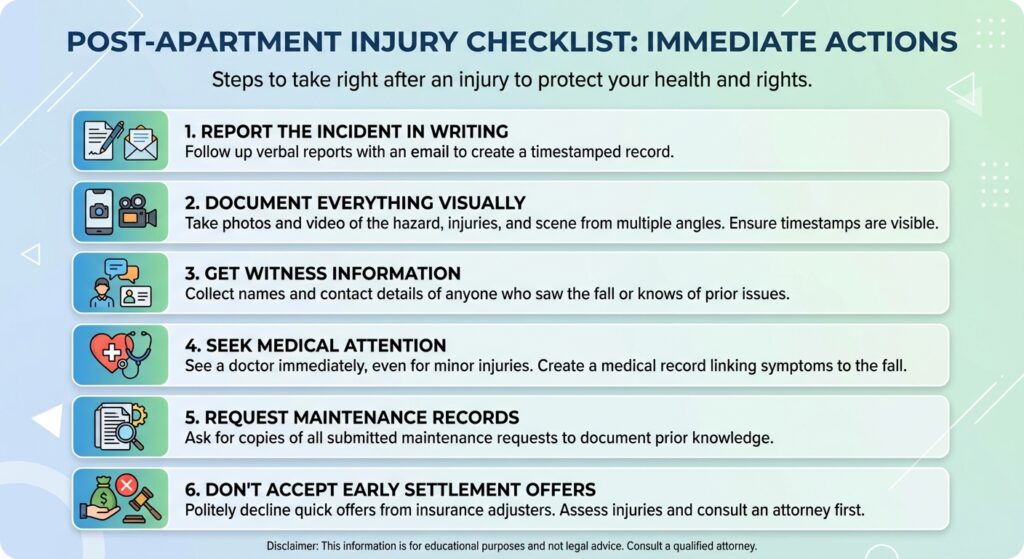
The steps you take immediately after your injury affect everything that comes later.
When Does Hiring an Attorney Make Sense?
Not every apartment slip and fall needs a lawyer. Minor injuries with clear liability sometimes settle through direct negotiation.
But if your injuries are serious, if the landlord denies responsibility, or if the insurance company offers amounts that don’t cover your medical bills, having representation changes the calculation. Attorneys know how to value cases, conduct discovery, and negotiate with insurance companies who do this every day.
Most personal injury attorneys work on contingency, meaning they don’t get paid unless you recover money. That removes the financial risk of hiring someone to help.
The Bottom Line
If you’ve been injured in a California apartment due to a landlord’s negligence, DK Law offers free consultations to evaluate your case.
Our premises liability attorneys have recovered millions for clients across our 13 California locations. Don’t hesitate to reach out to discuss your situation and understand your options.
전화 문의 또는 contact us online to talk through your case.
DK All the way


사고 직후부터 보상까지 all the way 함께
무료 상담 예약하기
교통사고 전문 변호사와 한국어 상담이 가능합니다. 무료 상담
DK Law에서 함께 합니다.
DK all the way
지금 바로 교통사고 전문 변호사와 무료 상담을 받아 보세요!