


What Doctor Should You See After a Car Accident?
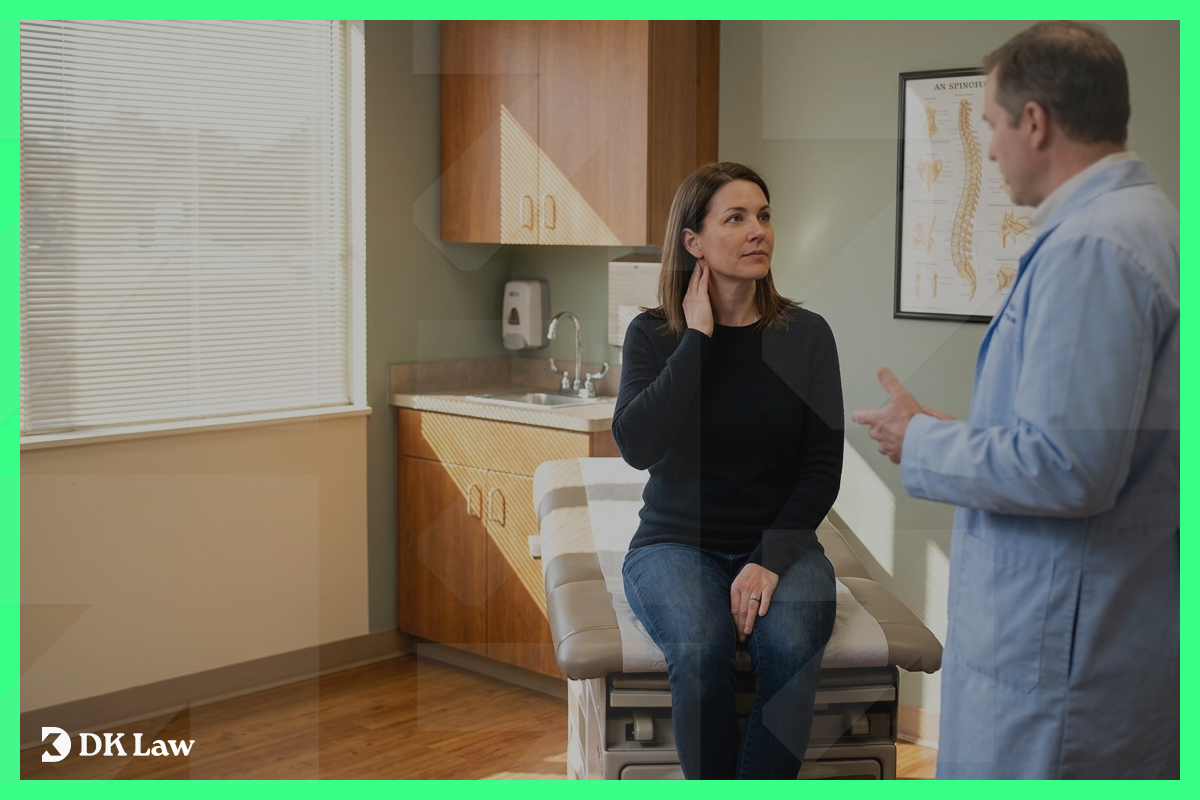
The provider you need after a crash depends on what hurts and how badly. Across most of the country, the path looks similar: emergency care for anything severe, urgent care or a primary care office for injuries that can wait a few hours, then specialists once symptoms sort themselves out.
Everything around that sequence is where it gets complicated. Which providers can legally order imaging. Which can prescribe. Why a primary care clinic might decline to see you at all. Whether waiting a week to be evaluated costs you anything on a claim. Each has a California-specific answer, and on the last one, California diverges from most of the country.
핵심 요약
- Severe symptoms go to an emergency department. Everything else typically starts at urgent care or a primary care office, then moves to specialists based on what the exam finds.
- Provider types have legally defined limits. A chiropractor can order and take X-rays for diagnosis but cannot prescribe medication or perform surgery.
- California physical therapists can be seen without a referral, but that direct access ends at 45 days or 12 visits, whichever comes first, unless a physician signs off on the plan of care.
- No California statute sets a deadline for getting medical care after a crash. The two-year filing deadline is separate, and it applies to the lawsuit, not the treatment.
- Primary care clinics decline auto-accident patients fairly often, and the reason is billing mechanics rather than anything about your injury.
Where People Go, and What Each Provider Checks
| Symptom or situation | Typically evaluated at | What that provider is checking for | Common referral from there |
|---|---|---|---|
| Lost consciousness, confusion, or struck your head | Emergency department | Bleeding inside the skull, skull fracture, altered mental status | Neurologist |
| Chest pain or pressure after airbag or steering wheel contact | Emergency department | Blunt cardiac injury, rib fracture, lung injury | Cardiology |
| Abdominal pain or bruising along the seatbelt line | Emergency department | Internal bleeding, organ injury | Trauma surgery |
| Neck or back pain that is severe or worsening | Emergency department or urgent care | Fracture, dislocation, nerve compression | Orthopedic surgeon, neurologist, or physiatrist |
| Numbness, tingling, or weakness in an arm or leg | Emergency department or urgent care | Nerve root or spinal cord involvement | Neurologist |
| Stiffness and soreness that appear a day or two later | Primary care or urgent care | Soft tissue injury, range of motion loss | Physical therapy, chiropractic, or physiatry |
| Trouble sleeping, anxiety, intrusive memories of the crash | Primary care | Acute stress response, post-traumatic stress disorder | Psychologist or psychiatrist |
Where Do People Go First After a Crash?
The emergency department handles the red flags, and urgent care handles most of what is left. The American College of Emergency Physicians lists the symptoms that warrant emergency evaluation, and one entry on that list is injury from a serious motor vehicle accident, stated outright. The rest of the list maps onto a bad crash anyway: head or spine injury, difficulty breathing, chest or upper abdominal pressure lasting two minutes or more, confusion or difficulty waking, changes in vision, uncontrolled bleeding, sudden severe pain.
Urgent care handles the middle ground. Lacerations, sprains, minor fractures – the kind of injury that needs attention today but may not require an ambulance.
We cover the emergency room versus urgent care decision separately, and whether to be seen at all when you feel fine separately from that.
Which Providers Treat What, and What They Are Allowed to Do
Each provider type operates inside a scope defined by California law, and the boundaries matter more than most people expect. A provider who cannot prescribe cannot manage your pain medication. A provider who cannot order advanced imaging has to send you somewhere that can.
Chiropractors. 아래 California’s chiropractic practice regulation, a licensed chiropractor may diagnose and may use X-ray equipment for diagnosis but not for treatment. The license does not authorize surgery, penetrating or severing tissue, or prescribing medication. Anything outside that scope has to be referred out. More on chiropractic care after a collision.
Physical therapists. California allows patients to start physical therapy without seeing a physician first. That direct access has a hard stop written into Business and Professions Code section 2620.1: a physical therapist cannot continue treating past 45 calendar days or 12 visits, whichever comes first, without a physician’s dated signature approving the plan of care after an examination. The statute also preserves the rule that physical therapists do not diagnose disease. Practically, that means a course of therapy longer than about six weeks requires a doctor in the loop. See our fuller piece on working with a physical therapist after a crash.
Physiatrists. A physiatrist is a physician who completed a residency in physical medicine and rehabilitation. The specialty focuses on restoring function after injury to the brain, spinal cord, nerves, bones, joints, ligaments, muscles, and tendons. They prescribe, they order imaging, and they usually coordinate the rest of the rehabilitation team.
Orthopedic surgeons. Orthopaedic surgery covers the musculoskeletal system: bones, joints, ligaments, muscles, nerves, and tendons. Fractures, torn ligaments, joint damage, and spinal injuries requiring surgical evaluation.
Neurologists. Neurologists diagnose and manage disorders of the brain, spinal cord, and nerves, including concussion. They do not perform brain or spinal cord surgery, which is the line between neurology and neurosurgery. Persistent headaches, numbness, memory problems, and dizziness after a head strike land here. When neck injury is the driver, our page on seeing a doctor for whiplash goes deeper.
Pain management physicians. Typically entered by referral when pain persists past the point where the initial treatment plan expected it to resolve. We have more on pain management after a collision.
What If Your Primary Care Doctor Will Not See You After an Accident?
This happens often enough that it surprises people who assume it is about their injury. It is about when the clinic gets paid. A visit billed to health insurance pays in weeks. A visit billed against a pending liability claim pays when the case resolves, which can be a year or more out, and the clinic has to carry that receivable in the meantime or secure it with a lien.
California gives certain providers a statutory tool here. The Hospital Lien Act gives a licensed hospital furnishing emergency and ongoing services to an accident victim an automatic lien on that patient’s recovery from the person who caused the crash. The lien attaches to a judgment, settlement, or compromise, requires written notice by registered mail to be perfected, and cannot exceed half the recovery after prior liens are satisfied.
Outpatient clinics generally have no equivalent statutory lien and no obligation to accept the patient. No California statute requires a private outpatient practice to take someone whose payment source is a liability claim.
What that means in practice: the clinic that turns you away is usually not making a judgment about whether you are hurt. Urgent care and specialty practices that handle accident cases routinely are the usual alternative.
Is It Too Late to See a Doctor After a Car Accident?
Probably not, and the 24- to 72-hour window that appears everywhere on this topic has no primary source behind it. No clinical guideline establishes it. No statute establishes it. It is a convention that spread through legal and clinical marketing until it started reading like a rule.
California imposes no deadline for medical treatment after a collision. Only one state does. Florida’s no-fault statute requires initial services within 14 days for personal injury protection benefits to apply, and Florida has personal injury protection in the first place. California does not. Deadlines described as treatment deadlines in other states are almost always claim notice requirements instead, which is a different thing.
What does carry weight in California is the duty to mitigate. A plaintiff has to use reasonable diligence caring for an injury, and a defendant who proves an unreasonable failure to do so can reduce damages by the portion that reasonable care would have avoided. The jury instruction on that duty puts the burden of proof on the defendant, not on you. And California case law is direct about the shape of the obligation: there is no hard and fast rule requiring an injured person to seek medical care of any particular type.
The real deadline is the filing deadline. California gives you two years from the date of injury to file a personal injury lawsuit. That governs the lawsuit. It says nothing about when you see a doctor.
Delay does have a practical cost, though it is not the one usually described. A three-week gap between the crash and the first visit gives an insurer room to argue something else caused the symptoms. That argument is easier to make against a thin record than a thick one.
This article is general information, not medical or legal advice. For care, see a licensed medical professional.
Does the Provider You Pick Change Your Claim?
What matters is whether the record clearly documents the injury, not whether the provider’s title sounds impressive. A chiropractor’s chart notes describing measured range of motion loss across eight visits carry more weight than a specialist visit that produced two sentences.
Where provider choice does matter is scope. Findings recorded by a provider working inside their licensed scope are harder to challenge than findings that reach past it. A physical therapist’s note characterizing a disc injury sits on weaker ground than the same characterization from a physician who ordered the imaging.
The format of the record matters too, and it varies more than people expect. Our piece on medical records versus narrative reports walks through the difference.
Talk to Someone Who Handles These Claims
Figuring out which provider to see, who pays, and how the record holds up later is a lot to manage while you are still hurting. DK Law handles injury claims across California, and a conversation about your situation costs nothing.
Call us or reach out through our site whenever you are ready.
DK All the way


사고 직후부터 보상까지 all the way 함께
상담 예약하기
1:1 맞춤 한국어 상담 무료로 진행하기
DK Law에서 함께 합니다.
DK all the way
지금 바로 교통사고 전문 변호사와 무료 상담을 받아 보세요!

교통사고 보상, 시간이 관건입니다!
사고 후 대처가 빠를수록, 교통사고 보상 더 잘 받을 수 있습니다. 사고의 초기 대응이 증거 보존 및 피해자 권리 보호에 큰 도움이 됩니다.
승소하지 않으면 변호사 선임료 $0 | 24시간 상담 가능