


California Carpool Lane Rules (2026): Who Can Use HOV Lanes?
Last updated: May 2026
HOV 차선 규칙 이해
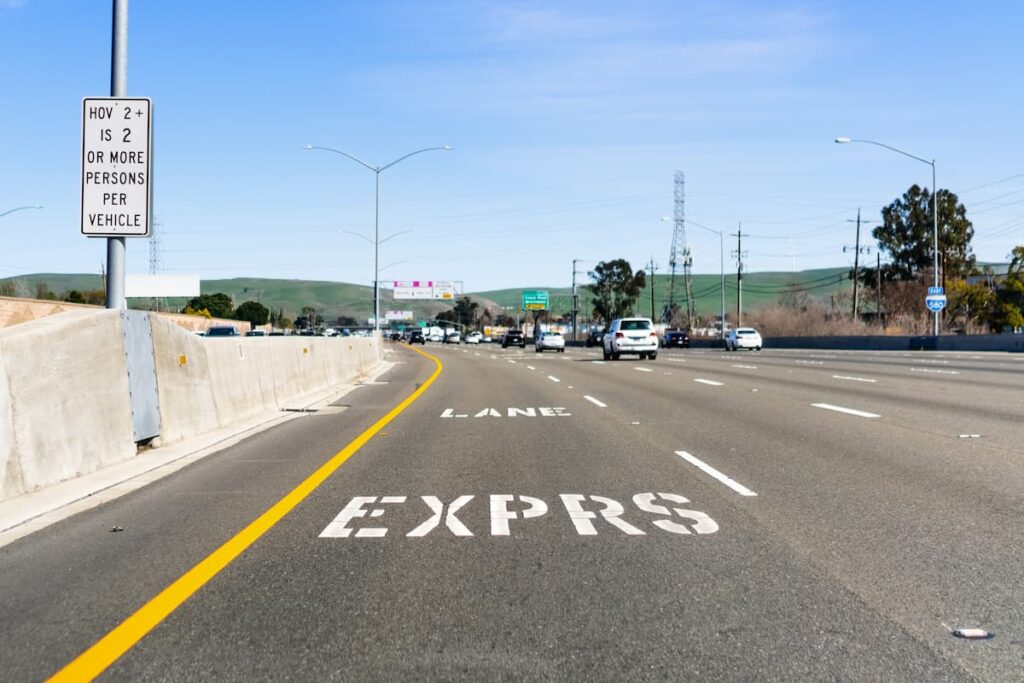
California carpool lanes, officially called High-Occupancy Vehicle (HOV) lanes and marked with a white diamond symbol, are reserved under California Vehicle Code § 21655.5 for vehicles carrying two or more occupants, motorcycles, and certain authorized vehicles. Solo drivers caught in an HOV lane face a minimum $490 fine.
As of October 1, 2025, Clean Air Vehicle decals are no longer valid, meaning solo EVs and plug-in hybrids can no longer use the HOV lane regardless of any sticker still displayed on the car.
Below is the complete 2026 breakdown of who can legally use California’s carpool lanes, who cannot, what the fines are, and what changed in 2025.
핵심 요약
- Minimum occupancy: 2 or more people in most HOV lanes; some express lanes require 3+ during peak hours
- Governing statute: California Vehicle Code § 21655.5 (HOV lane use) and § 21655.8 (crossing double lines)
- Solo HOV violation fine (CVC § 21655.5): $490 minimum, no DMV points, does not raise insurance
- Double-line crossing fine (CVC § 21655.8): ~$480 plus 1 DMV point, moving violation that can raise insurance premiums for 3 to 5 years
- Clean Air Vehicle decals: Expired October 1, 2025. No longer valid for solo HOV use.
- 모터사이클: Always allowed regardless of occupancy, per CVC § 21655.5
- Operating hours: Vary by route. Southern California HOV lanes are typically 24/7. Northern California HOV lanes typically operate during peak commute hours only (often 5 a.m. to 9 a.m. and 3 p.m. to 7 p.m., Monday through Friday). Always follow posted signs.
- Who counts as a passenger: Any living human being, including infants and children. Pets, unborn children, and mannequins do not count.
What Is a Carpool (HOV) Lane?
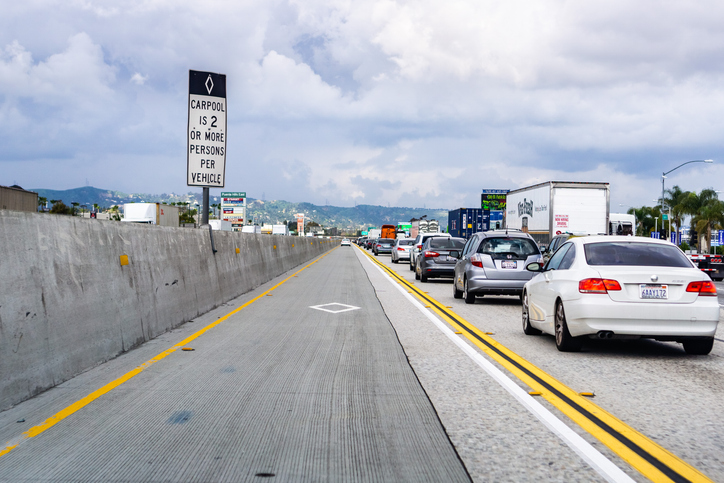
An HOV lane is a highway lane reserved for high-occupancy vehicles to reduce traffic congestion, lower emissions, and incentivize ridesharing. In California, HOV lanes are typically the left-most lane and are marked with a white diamond painted on the pavement.
The statutory authority for HOV lanes is California Vehicle Code § 21655.5, which gives the California Department of Transportation (Caltrans) and local authorities the power to designate preferential lanes and to penalize drivers who use them improperly.
California operates three types of HOV lanes:
- 풀타임 HOV 차선: In effect 24 hours a day, 7 days a week. Common in Southern California, including on the 405, 605, 110, and 105 freeways.
- 시간제 HOV 차선: Restricted only during peak commute hours. Outside those hours, any vehicle may use the lane. Common in Northern California, including in the Bay Area.
- Express lanes (also called HOT lanes): High-Occupancy Toll lanes that allow solo drivers to pay a toll for access via a FasTrak transponder. Some express lanes, like the I-10 and I-110 in Los Angeles, require 3 or more occupants for free use during peak hours. Examples of express lane systems include the 91 Express Lanes in Orange County, the I-10 and I-110 ExpressLanes in Los Angeles, and the I-680 Express Lanes in the Bay Area.
Hours and occupancy requirements vary significantly by route. Always follow posted signs at the lane entrance.
Who Can Use the Carpool Lane in California?
Under California Vehicle Code § 21655.5, the following vehicles are authorized to use HOV lanes:
- Vehicles with two or more occupants (some express lanes require three or more during peak hours)
- Motorcycles are always permitted, regardless of occupancy, unless signs specifically prohibit them
- Public transit buses and vanpools meeting occupancy requirements
- Emergency response vehicles in the course of their duties
- Vehicles carrying infants and children, since all living human passengers count toward occupancy regardless of age
A child in a car seat counts. An infant in a rear-facing seat counts. Any living person physically inside the vehicle counts as an occupant.
Who Cannot Use the Carpool Lane?
The following vehicles are prohibited from HOV lanes regardless of hour or intent:
- Solo drivers who do not qualify for an exception
- Solo drivers in electric vehicles or plug-in hybrids, even with a Clean Air Vehicle decal still on the car (see next section)
- Vehicles towing trailers of any kind, commercial or recreational
- Commercial trucks over 6,000 pounds unless specifically permitted
- Learner’s permit drivers, even if they have qualifying passengers, because a permit holder cannot drive unsupervised on a freeway
- Rideshare drivers with no passengers (empty Uber, Lyft, or similar vehicles)
- Vehicles using mannequins, dolls, or inflatable figures as fake passengers. This is not only a carpool lane violation, but it can result in additional charges for fraudulent use.
Pets do not count as passengers. Neither do unborn children. A pregnant driver is still considered a solo driver under California law. Pets of any size, number, or species are not occupants for HOV purposes.
What Changed in 2025: The End of the Clean Air Vehicle Decal Program
For more than 25 years, California has allowed qualifying single-occupant electric vehicles, plug-in hybrids, and hydrogen fuel-cell vehicles to use HOV lanes with a Clean Air Vehicle (CAV) decal issued by the DMV. That program ended on September 30, 2025.
The CAV decal program operated under Section 166 of Title 23 of the United States Code, which required federal authorization. The federal government did not extend the authorization, and California was unable to continue the program on its own. The DMV stopped accepting new and replacement decal applications on August 29, 2025.
What this means for California drivers in 2026:
- All CAV decals are invalid, regardless of the expiration date printed on them
- Solo drivers in EVs, plug-in hybrids, and hydrogen vehicles can no longer use HOV lanes unless they carry the required number of passengers or pay the applicable toll in express lanes
- Reduced toll rates for clean air vehicles in express lanes have ended. Full toll rates apply.
- A 60-day grace period on enforcement ended December 1, 2025. Solo EVs using HOV lanes now face full citations
There is no current federal authorization allowing California to restart the program. Drivers should not rely on any CAV decal still displayed on their vehicle, even one that has not yet reached its original expiration date. The decal does not have to be removed, but it is no longer legally valid for HOV lane use.
Crossing Solid or Double Lines
California Vehicle Code § 21655.8 governs how drivers enter and exit HOV lanes. Drivers may only cross into or out of an HOV lane where a single broken line (white or yellow) is painted. Crossing a solid double line to enter or exit an HOV lane is illegal.
This is a separate offense from a solo HOV violation, with different consequences:
| Violation | Statute | Fine (Base) | DMV Points | Insurance Impact |
|---|---|---|---|---|
| Solo driver in HOV lane | CVC § 21655.5(b) | $490 | 0 | None (non-moving violation) |
| Crossing double lines | CVC § 21655.8 | ~$480 | 1 | Yes (moving violation) |
The double-line crossing is the more serious offense. A single point on a California driving record from a CVC § 21655.8 violation can raise auto insurance premiums for 3 to 5 years, typically costing the driver far more than the ticket itself. It is also the more dangerous offense, since sudden lane changes across double lines are a frequent cause of sideswipe and rear-end collisions in the HOV lane.
Carpool Lane Fines in California
California’s HOV lane fines are some of the highest in the country for a non-moving violation:
- CVC § 21655.5(b) (solo HOV use): $490 base fine; total often exceeds $600 with court fees and penalty assessments. Not a moving violation, no DMV points, no direct insurance impact.
- CVC § 21655.8 (crossing double lines): Approximately $480 base fine. Moving violation. 1 DMV point. Can raise insurance premiums for 3 to 5 years.
- CVC § 21655.9(c) (fraudulent CAV decal): Misdemeanor. This was used when the CAV program was active and applies retroactively to decal fraud. Penalties can include fines and jail time.
Fines vary modestly by county. A ticket issued in Los Angeles County may cost slightly more than one issued in Sacramento County due to local court fees. Repeat violations within a short period can also lead to higher penalties.
자주 묻는 질문
Can single-occupant electric vehicles use California carpool lanes in 2026?
No. The federal Clean Air Vehicle decal program ended September 30, 2025. As of October 1, 2025, solo drivers in EVs and plug-in hybrids are subject to the same HOV lane rules as any other vehicle. They must carry the required number of occupants or pay the posted toll on express lanes. A CAV decal still displayed on a vehicle is no longer valid.
Can motorcycles use the HOV lane in California?
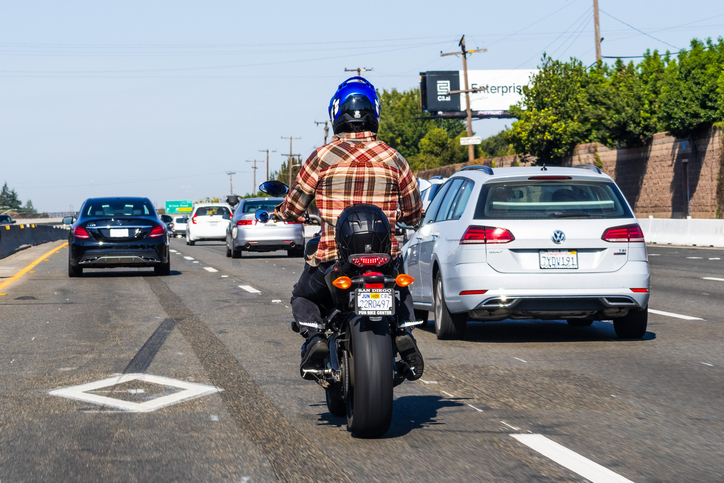
Yes. California Vehicle Code § 21655.5(b) allows motorcycles to use HOV lanes regardless of the number of occupants, unless signs specifically prohibit them in a given location. Motorcyclists must still obey lane-change rules and cannot cross solid double lines to enter or exit the HOV lane.
Do kids or infants count as passengers in the carpool lane?
Yes. California law considers any living human being an occupant for HOV purposes. This includes infants, toddlers, and children in car seats. There is no minimum age requirement. A parent driving with a newborn in a rear-facing car seat meets the 2+ occupancy requirement.
Can a pregnant woman drive in the carpool lane alone in California?
No. Under California law, an unborn child does not count as a passenger for HOV lane purposes. A pregnant driver alone in the vehicle is still considered a solo driver and can be cited under CVC § 21655.5(b).
Do dogs or pets count for the HOV lane?
No. Pets of any kind (dogs, cats, service animals, or otherwise) do not count as passengers. A solo driver with a dog in the car can still be cited for an HOV violation.
What is the minimum fine for driving in the carpool lane alone in California?
The minimum base fine under CVC § 21655.5(b) is $490. With court fees and penalty assessments, the total often exceeds $600. The violation does not add points to a DMV record and is not classified as a moving violation, so it typically does not raise auto insurance premiums directly.
What are the operating hours for California carpool lanes?
Southern California HOV lanes are generally in effect 24 hours a day, 7 days a week. Northern California HOV lanes typically operate only during peak commute hours, often 5 a.m. to 9 a.m. and 3 p.m. to 7 p.m., Monday through Friday. Hours vary by route. Always follow the posted signs at the lane entrance.
What is a diamond lane?
A diamond lane is another name for a carpool or HOV lane, named after the white diamond symbol painted on the pavement. The diamond marks the lane as restricted to vehicles meeting the occupancy requirement during posted hours.
Can semi trucks drive in the California carpool lane?
No. Commercial trucks over 6,000 pounds, big rigs, and semi-trucks are prohibited from California HOV lanes regardless of occupancy. Vehicles towing trailers are also prohibited.
What happens if I cross the double yellow line into the HOV lane?
Crossing a solid double line to enter or exit an HOV lane is a violation of CVC § 21655.8. The base fine is approximately $480, and it is a moving violation that adds one point to the driver’s DMV record. The point can raise insurance premiums for 3 to 5 years.
Can I use the carpool lane to avoid an accident?
Yes, in a genuine emergency. A driver may cross into the HOV lane to avoid an imminent collision, but must exit as soon as safely possible. Emergency avoidance is a recognized legal defense under CVC § 21655.5 if the driver can demonstrate the necessity. Staying in the HOV lane after the hazard has passed risks a citation.
Are mannequins or fake passengers a defense to an HOV ticket?
No. Using a mannequin, doll, or inflatable figure as a fake passenger is not a defense. It is an aggravating factor. California courts treat this as fraudulent HOV lane use and may impose additional penalties beyond the standard $490 fine.
What should I do if I was in an accident in the carpool lane?
If another driver caused a crash by crossing double lines, weaving in and out of the HOV lane, or otherwise violating carpool lane rules, you may have a legal claim for compensation. California follows a pure comparative fault rule, meaning fault can be split between parties.
An experienced California car accident lawyer can help determine liability, deal with insurance companies, and pursue compensation for medical bills, lost wages, and other damages.
When HOV Lane Accidents Happen
Carpool lane accidents are often caused by drivers who cross solid double lines, weave between HOV and regular lanes, or drive aggressively at high speeds. When another driver’s violation of CVC § 21655.8 causes a collision, the injured party may have grounds for a personal injury claim.
If you or a loved one were injured in an HOV lane accident in Los Angeles, Irvine, or anywhere else in California, DK Law offers free consultations and represents accident victims throughout the state.
Contact us at (800) 719-9779 또는 메시지 보내기 온라인에서 무료 상담을 받으세요.
DK All the way


사고 직후부터 보상까지 all the way 함께
상담 예약
1:1 맞춤 한국어 상담 무료로 진행하기
DK Law에서 함께 합니다.
DK all the way
지금 바로 교통사고 전문 변호사와 무료 상담을 받아 보세요!

교통사고 보상, 시간이 관건입니다!
사고 후 대처가 빠를수록, 교통사고 보상 더 잘 받을 수 있습니다. 사고의 초기 대응이 증거 보존 및 피해자 권리 보호에 큰 도움이 됩니다.
승소하지 않으면 변호사 선임료 $0 | 24시간 상담 가능