


Insights – Estadísticas de accidentes de motocicleta y automóvil en 2026
Estadísticas de accidentes de motocicleta versus coche en 2026
La diferencia entre las tasas de mortalidad en motocicletas y automóviles es mayor de lo que la mayoría de la gente se da cuenta. Aquí está lo que dicen los números y por qué es importante.
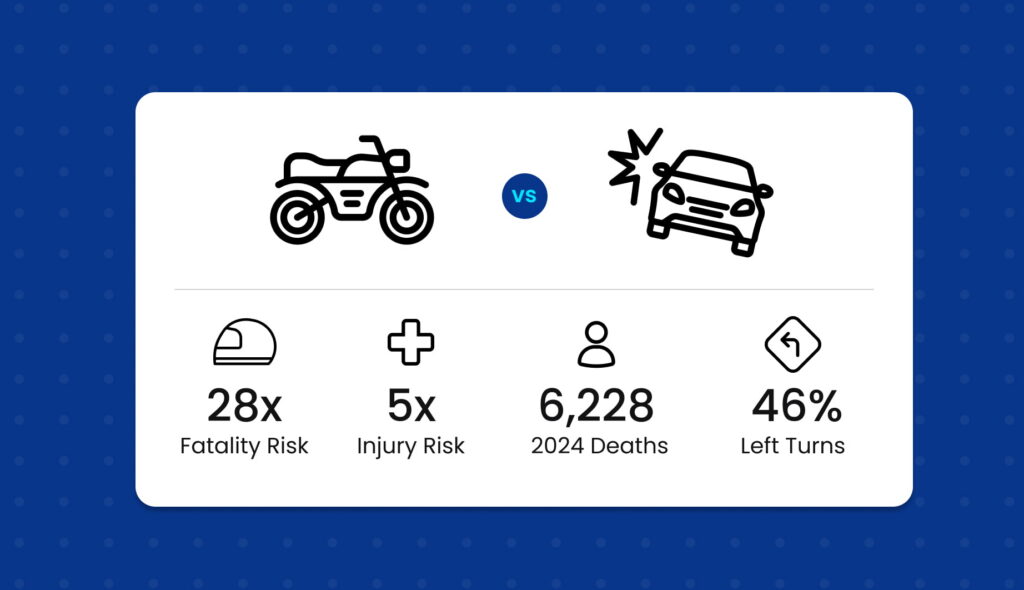
Según la Administración Nacional de Seguridad en la Carretera (NHTSA), los motociclistas tienen casi 28 veces más probabilidades de morir en un accidente que las personas que conducen automóviles. Esta estadística explica por qué la seguridad de las motocicletas recibe un tratamiento tan diferente que la de los automóviles, a pesar de que cada año mueren mucho más personas en los automóviles.
A continuación se presentan 18 estadísticas verificadas que comparan los accidentes de motocicleta y automóvil, extraídas de la NHTSA, el Insurance Institute for Highway Safety (IIHS) y el National Safety Council (NSC). Comenzamos con los números en cifras absolutas, luego explicamos por qué existe la diferencia y terminamos con lo que significa esto en California y para los reclamos por accidentes.
| Métrica (más reciente disponible) | Motocicleta | Automóvil de pasajeros | Fuente |
|---|---|---|---|
| Muertes por cada 100 millones de millas recorridas por vehículo, 2023 | 31.39 | 1.13 | NHTSA |
| Riesgo de mortalidad relativo por kilómetro, 2023 | ~28 veces más alto | 1x (línea de base) | NHTSA |
| Heridas por cada 100 millones de millas recorridas por vehículo, 2023 | 409 | 88 | NHTSA |
| Total de muertes de ciclistas y ocupantes, 2023 | 6,335 | 23,959 | NHTSA |
| Porcentaje de todas las muertes en accidentes de tráfico en Estados Unidos, 2023 | 15% | 59% | NHTSA |
| Porcentaje de todos los vehículos registrados | ~3% | Mayoría | NSC, 2024 |
Accidentes de motocicleta vs. automóviles: estadísticas clave
- Por cada milla recorrida, los motociclistas tenían casi 28 veces más probabilidades de morir que los ocupantes de automóviles en 2023: 31,39 frente a 1,13 muertes por cada 100 millones de millas recorridas en vehículo (NHTSA).
- En 2024, el año más reciente para el que existen datos federales, murieron 6.228 motociclistas, lo que representa el 16% de todas las muertes en accidentes de tráfico en Estados Unidos (NHTSA).
- El año más reciente con datos finalizados para ambos tipos de vehículos muestra que 6.335 motociclistas murieron frente a 23.959 ocupantes de vehículos de pasajeros, de un total de 40.901 muertes en tráfico en Estados Unidos (NHTSA).
- En 2023, los motociclistas tenían casi cinco veces más probabilidades de sufrir lesiones que los ocupantes de automóviles, con una tasa de lesiones de 409 contra 88 por cada millón de millas recorridas en vehículo (NHTSA).
- Las motocicletas representaron aproximadamente el 3% de los vehículos registrados, pero el 15% de todas las muertes en accidentes de tráfico en Estados Unidos (NHTSA, 2023; NSC, 2024).
- Las 6.335 muertes de ciclistas en 2023 representaron el mayor total anual desde que comenzó la contabilidad federal en 1975 (IIHS; NHTSA).
- En los accidentes fatales entre una motocicleta y otro vehículo, el otro vehículo giraba a la izquierda en un 46% de los casos en 2023 (NHTSA).
- Los cascos protegen aproximadamente un 37% contra la muerte de los ciclistas y un 67% contra las lesiones cerebrales (NHTSA).
- En los estados que no tienen leyes universales sobre el uso de casc, 51% de los ciclistas muertos en 2023 no llevaban casco, en comparación con 10% en los estados que requieren el uso de casco (NHTSA).
- 41% de los motociclistas muertos en accidentes con un solo vehículo en 2023 estaban bajo los efectos del alcohol, la tasa más alta de cualquier tipo de vehículo (NHTSA).
- El número de fallecimientos de motociclistas mayores de 50 años aumentó de 3% en 1975 a 33% en 2023, y el promedio de fallecimientos de los motociclistas fue de 41 (IIHS).
- En California, en 2023 murieron 583 motociclistas, una disminución de 10,2% respecto de los 649 de 2022 (Oficina de Seguridad Vial de California).
1. ¿En qué medida un motociclista es más peligroso que un coche, por kilómetro?
Por cada milla recorrida, los motociclistas tenían casi 28 veces más probabilidades de morir que los ocupantes de vehículos de pasajeros. La NHTSA registró 31,39 muertes de motociclistas por cada 100 millones de millas recorridas (VMT), en comparación con 1,13 para los ocupantes de vehículos de pasajeros. Esta medida por milla es la forma más justa de comparar los dos, ya que tiene en cuenta cuánto cada tipo de vehículo está realmente en la carretera. También es la cifra en la que confían tanto la NHTSA como el IIHS, y la razón por la que “los motociclistas son peligrosos” es una afirmación sobre la exposición, no sobre la imprudencia del piloto. (Para 2024, los datos preliminares de la NHTSA sitúan la cifra en casi 27 veces.)
2. ¿Cuántos ciclistas mueren cada año en accidentes con vehículos?
En 2023, 6.335 motociclistas fueron asesinados en Estados Unidos, en comparación con 23.959 ocupantes de vehículos de pasajeros, de un total de 40.901 muertes en accidentes de tráfico (NHTSA). A primera vista, eso hace que los automóviles parezcan mucho más peligrosos, con aproximadamente cuatro veces más muertes. El problema es la exposición. Los automóviles representan la abrumadora mayoría de las millas recorridas, mientras que las motocicletas representan menos del 1% de las millas recorridas por los vehículos. Los recuentos brutos de muertes miden la frecuencia con la que cada vehículo se utiliza, no la peligrosidad de su uso.
3%. Las motocicletas son un tipo de vehículo, pero representan el 15% de las muertes en accidentes de tráfico
Las motocicletas representan alrededor de 3% de todos los vehículos registrados en los Estados Unidos, pero fueron responsables de 15% de todas las muertes en accidentes de tráfico. Esa diferencia de cinco a uno entre la presencia en la carretera y la proporción de muertes es una de las ilustraciones más claras del diferendo de riesgo. El NSC reporta la misma disparidad para 2024: 3% de los vehículos registrados, 16,2% de las muertes y solo 3,6% de las lesiones. Esta última cifra refleja la frecuencia con la que un accidente de motocicleta resulta mortal en lugar de simplemente lesionoso.
4. ¿Son más propensos a chocar las motocicletas o los automóviles?
Los automóviles son los involucrados en muchos más accidentes en términos absolutos, simplemente porque son mucho más numerosos y se conducen mucho más a menudo. Por cada milla recorrida, el ciclismo de moto presenta probabilidades mucho más elevadas de sufrir un accidente fatal o con lesiones. Así que la respuesta depende de la pregunta. Si se pregunta qué tipo de vehículo produce más accidentes totales, son los automóviles. Si se pregunta cuál es el más arriesgado para el usuario, la respuesta es el ciclomotor, con mucha diferencia. Este rasgo dificulta la mayoría de las comparaciones entre ambos.
5. Los ciclistas tienen casi cinco veces más probabilidades de sufrir lesiones por cada kilómetro recorrido
Además de las víctimas mortales, los motociclistas tenían casi cinco veces más probabilidades de sufrir lesiones por cada milla recorrida que los ocupantes de los vehículos de motor, con una tasa de lesiones de 409 por cada 100 millones de VMT frente a 88 para los vehículos de pasajeros (NHTSA). Se calcula que en un solo año fueron víctimas de lesiones 82.564 motociclistas. En muchos artículos aparece una afirmación muy difundida según la cual “80% de los accidentes de motocicleta causan lesiones o muertes frente a 20% para los vehículos de pasajeros”, pero no tiene ninguna fuente gubernamental verificable y contradice los propios datos de gravedad de los accidentes de la NHTSA, por lo que los hemos dejado fuera. La tasa de lesiones por milla documentada anterior es la comparación verificada.
6. Las muertes en motocicletas alcanzaron un récord en 2023
Los 6.335 motociclistas muertos en 2023 representaron el mayor total anual desde que el gobierno federal comenzó a recopilar los datos en 1975, y aproximadamente tres veces el número de muertes en 1997 (IIHS; NHTSA).
Los datos preliminares de 2024 muestran una ligera disminución a 6.228, aproximadamente un descenso del 2%, pero la tendencia a largo plazo ha seguido ascendiendo a pesar de que las muertes por tráfico generalizaron. En 2023, las muertes por tráfico en Estados Unidos cayeron un 4,3% respecto al año anterior, mientras que las muertes de motociclistas aumentaron un 1,3%, lo que significa que los ciclistas representaron una parte creciente de una cifra que se reducía.
7. El problema de la vuelta a la izquierda: el accidente mortal más común para los ciclistas
El tipo de colisión más común en las muertes de motociclistas es cuando un coche gira a la izquierda por encima del camino del motociclista. De los accidentes fatales en los que participa un motociclista y otro vehículo, en 46% casos el otro vehículo giraba a la izquierda mientras el motociclista seguía recto, pasando o adelantando (NHTSA). La larga campaña de seguridad de los conductores de la NHTSA cita una cifra similar de 42% muertes. En cualquier caso, el coche que gira a la izquierda es el tipo de accidente fatal múltiple más común en motocicletas, y suele implicar a un conductor que no vio a un motociclista que se acercaba o que no calculó correctamente la velocidad del motociclista.
8. “Miró, pero no pudo ver”: ¿Por qué los conductores pasan por alto a las motocicletas
Una gran proporción de accidentes de tráfico entre vehículos y motocicletas ocurre porque el conductor miró pero no detectó la presencia de la motocicleta, una percepción errónea documentada más que una simple falta de atención. La NHTSA atribuye una parte considerable de los accidentes de motocicleta a conductores que no vieron a los pasajeros. Los investigadores señalan dos mecanismos.
En primer lugar, el perfil estrecho de una motocicleta es fácil de pasar por alto con un vistazo rápido.
En segundo lugar, un ciclista que se acerca en una trayectoria de colisión produce poca oscilación lateral, por lo que el ojo no detecta su movimiento hasta que se encuentra peligrosamente cerca. Además, los conductores suelen malinterpretar la velocidad con la que se aproxima un objeto pequeño y lejano, un efecto visual conocido que hace que los conductores parezcan más alejados y más lentos de lo que realmente son.
9. ¿Los cascos realmente hacen una diferencia?
Sí, y el efecto está bien documentado. Según la NHTSA, los cascos protegen aproximadamente un 37% de las muertes de ciclistas y un 67% de las lesiones cerebrales. En otras palabras, los cascos reducen el riesgo de muerte en un accidente en más de un tercio, y los ciclistas sin casco tienen aproximadamente tres veces más probabilidades de sufrir una lesión cerebral traumática. El CDC reporta una cifra relacionada estrechamente con esto, de 69%, para la prevención de lesiones cerebrales. Estos números son el centro de casi todos los debates sobre la seguridad de las motocicletas.
10. El mapa de la Ley de Cascos: dónde se concentran los muertes sin casco
El uso de cascavillas entre los motociclistas muertos en accidentes se corresponde estrechamente con la legislación estatal. En 2023, 51% de los motociclistas muertos en estados sin leyes universales sobre el uso de cascavillas no llevaban casco, en comparación con solo 10% en estados con leyes universales sobre el uso de cascavillas (NHTSA). California es uno de los estados con una ley universales sobre el uso de cascavillas, que requiere que todos los motociclistas lleven casco independientemente de su edad. Este contraste es uno de los experimentos naturales más evidentes en materia de seguridad vial. En los estados donde la ley exige el uso de cascavillas, mucho menos de los motociclistas que mueren no llevan casco.
11. El alcohol es un factor más importante para los conductores que para cualquier otro tipo de conductores
Los motociclistas tienen la tasa más alta de alteración de la capacidad de conducción por alcohol de cualquier tipo de vehículo en accidentes mortales. En 2023, 41% de los motociclistas que murieron en accidentes con un solo vehículo estaban bajo los efectos del alcohol (NHTSA). En todos los accidentes mortales, 26% de los motociclistas estaban bajo los efectos del alcohol, en comparación con 24% de los conductores de automóviles, 20% de los conductores de camiones ligeros y 4% de los conductores de camiones pesados. El estado de alteración es especialmente peligroso en una motocicleta, donde el equilibrio, el tiempo de reacción y la capacidad de juicio son aún más importantes que en un automóvil.
12. El sorprendente aumento de los fallecimientos en accidentes mortales entre los ciclistas mayores
El motociclista promedio que muere en un accidente ha envejecido significativamente en las últimas décadas. En 1975, los motociclistas menores de 30 años representaban alrededor del 80% de las muertes de motociclistas, pero en los últimos años solo representaron el 30%; mientras que los motociclistas de 50 años o más pasaron de 3% muertes a 33% durante el mismo período (IIHS).
13. La velocidad es el factor más común de accidentes
La velocidad es una de las principales causas de accidentes mortales con motocicletas, y parece que es la causa más común de muertes en este tipo de vehículos que en otros tipos de vehículos. La NHTSA identifica la velocidad como una contribución recurrente a las muertes de ciclistas, y los datos de accidentes de California corroboran esta afirmación.
La velocidad no segura fue el factor primario más común en los accidentes de motocicleta mortales y con lesiones graves en el estado, con un 28,2%, por delante de las maniobras de giro inadecuadas y las infracciones de derecho de paso (UC Berkeley SafeTREC). Velocidades más altas reducen el tiempo que el ciclista tiene para reaccionar y aumentan drásticamente la energía implicada en un accidente.
14. ¿Por qué las reclamaciones por accidentes de motocicleta suelen implicar daños más elevados?
Las reclamaciones por accidentes de motocicleta suelen implicar lesiones más graves y, por lo tanto, un mayor potencial de daños que las reclamaciones típicas por accidentes de automóvil. La razón es la gravedad, no el tipo de vehículo. Dado que los ciclistas sufren lesiones catastróficas con más frecuencia, sus costos médicos, pérdida de ingresos y necesidades a largo plazo suelen ser mayores.
El análisis de DK Law sobre datos reales del acuerdo y fallo de 2026 muestra que el tamaño de los pagos depende principalmente de la gravedad de la lesión, de quién es la parte responsable y del estado en el que se presenta la reclamación, y no del tipo de vehículo involucrado. Las reclamaciones por motocicletas también presentan obstáculos legales específicos.
Las aseguradoras pueden presentar una “defensa de casco” para argumentar que las lesiones de un pasajero habrían sido menos graves con un casco, un argumento que es más débil en California, donde los cascos son obligatorios y la mayoría de los pasajeros los llevan. Los jurados a veces también tienen una parcialidad injusta contra los pasajeros.
Dado que California aplica la teoría de la negligencia pura, incluso un hallazgo modesto de culpa del asegurado puede reducir la indemnización, por lo que es importante contar con una representación experta. abogados de accidentes de motocicleta es muy importante.
Preguntas frecuentes
¿Es más probable que ocurran accidentes con coches o motocicletas? Los automóviles son los causantes de un número mayor de accidentes en total, debido a que hay muchos más de ellos en la carretera. Por cada kilómetro recorrido, las motocicletas presentan un riesgo mucho mayor de sufrir un accidente mortal o con lesiones. La respuesta depende de si se refiere a los accidentes totales (automóviles) o al riesgo por kilómetro recorrido (motocicletas).
¿Cuál es la tasa de mortalidad de una motocicleta en comparación con un automóvil? En 2023, hubo 31,39 muertes de motociclistas por cada 100 millones de millas recorridas en vehículo, en comparación con 1,13 para los ocupantes de automóviles de pasajeros, lo que hace que la motocicleta sea casi 28 veces más letal por milla (NHTSA).
¿Cuántas muertes en motocicletas hay en comparación con los accidentes de coche? En 2023, 6.335 motociclistas y 23.959 ocupantes de vehículos de pasajeros murieron en accidentes de tráfico en Estados Unidos (NHTSA). Los motociclistas representaron el 15% de todas las muertes en accidentes de tráfico, aunque solo constituyen alrededor del 3% de los vehículos registrados.
¿En qué medida es más peligroso conducir una motocicleta que un automóvil? Por cada kilómetro recorrido, un motociclista tiene aproximadamente 28 veces más probabilidades de morir y aproximadamente 5 veces más probabilidades de sufrir lesiones que un ocupante de un automóvil (NHTSA, 2023). Este déficit se debe principalmente a la falta de protección física en una motocicleta.
Consulte a un abogado especializado en accidentes de motocicleta
Las reclamaciones por accidentes de motocicleta no son iguales que las reclamaciones por accidentes de automóvil. Las lesiones pueden ser más graves, la discriminación contra los conductores es real y los argumentos jurídicos que utilizan las aseguradoras son diferentes. Necesita un abogado que maneje estos casos con regularidad y que entienda qué esperar.
DK Law se ocupa de casos de accidentes de motocicleta y vehículos motorizados. Ofrecemos consultas gratuitas y trabajamos bajo la modalidad de honorarios por concepto de contingencia, lo que significa que solo se le pagará si conseguimos recuperar el dinero para usted. Si sufrió lesiones en un accidente de motocicleta en cualquier lugar de California, póngase en contacto con DK Law. Sin presión, sin obligación.
Llame a nuestro número 833-415-1770 o Solicite una evaluación gratuita del caso hoy.
Fuentes de datos: NHTSA, Datos sobre seguridad vial: Motocicletas, datos de 2023 (DOT HS 813 732), NHTSA, Seguridad de la motocicleta (Datos de 2024), IIHS, Datos de mortalidad 2023: Motocicletas y vehículos todo terreno, Consejo Nacional de Seguridad, Datos sobre las lesiones: Motocicletas (2024), Oficina de Seguridad Vial de California, Estadísticas Rápidas de Seguridad Vial (ots.ca.gov), UC Berkeley SafeTREC, 2025 Datos sobre la seguridad vial: Seguridad de los motociclistas; Estudio de 2015 sobre la división de la carretera. Los resultados anteriores no garantizan ni predecen un resultado similar en ningún caso futuro.
Experiencia jurídica
15
Anos de liderazgo jurídico bajo la dirección de Daniel Kim, veterano del ejército estadounidense y abogado gerente.
Eventos comunitarios
20+
Turquia Drive anual, Fighters For You y iniciativas locales de seguridad que apoyan a nuestros barrios.
Opiniones de 5 estrellas
5.0
Un historial consistente de servicio excepcional respaldado por opiniones reales y verificadas de los clientes.
¿Por qué DK Law hace la diferencia?
La experiencia jurídica, el impacto en la comunidad y los resultados comprobados: tres razones por las que los clientes confían en nosotros cuando todo está en juego.
Explore lo que más le importa
Buscando por ubicación o tipo de caso, le ayudaremos a llegar exactamente a donde necesita.
Ubique nuestra oficina más cercana.
Navegue por todas las ciudades y condados que atendemos. Vea en qué lugares nuestros abogados triunfan todos los días.

Explore las áreas de enfoque legal
Desde accidentes automovilísticos hasta demandas por muerte por negligencia, conozca todos los tipos de casos que manejamos con confianza.

DK All the Way


Desde su primer contacto hasta recibir su compensación, estamos con todos all the way.
Agende una consulta gratuita
Reciba asesoría legal experta sin ningún costo.
En DK Law estamos a su lado — all the way.
¡Agende hoy su consulta gratuita con nuestros expertos!

El tiempo es importante después de un accidente
Cuanto antes hables con un abogado después de un accidente, más sólido puede ser su reclamo. Actuar pronto ayuda a preservar la evidencia y a proteger sus derechos.
No ganamos, no cobramos | Disponible 24/7