


MedPay vs. PIP: Qué cubre cada uno y qué sucede con su compensación
Enlaces directos a las páginas oficiales de cobertura de PIP y MedPay de diez importantes aseguradoras de automóviles.
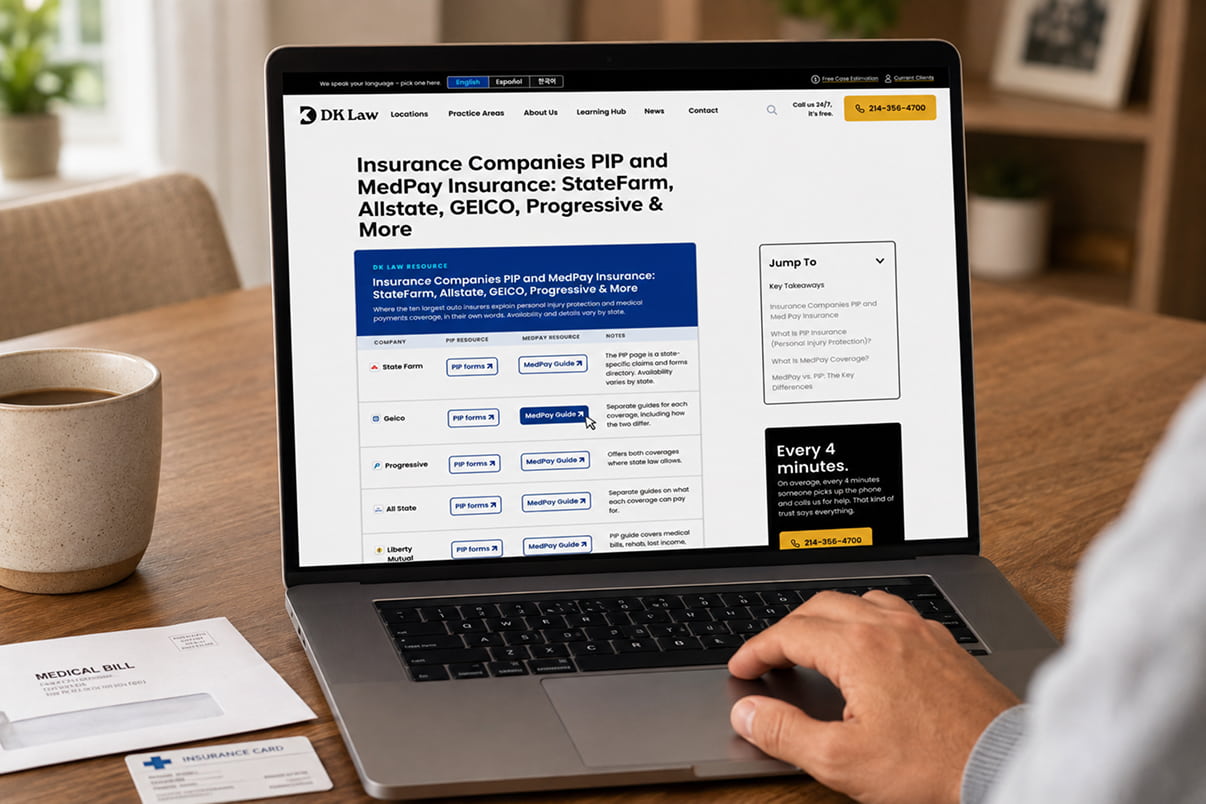
Tanto MedPay como PIP son complementos de una póliza de seguro de automóvil. Ambos pagan las facturas médicas tras un accidente, independientemente de quién lo haya provocado. Ambos tienen nombres que no dicen casi nada sobre cómo funcionan.
Las diferencias reales se hacen evidentes en dos lugares: lo que pagan además de los gastos médicos, y lo que pasa con ese dinero cuando se llega a un acuerdo con el conductor que te golpeó. Uno de ellos puede quedarse con una parte de tu compensación sin que te des cuenta. El otro, por lo general, no puede hacerlo.
También hay una pregunta límite: ¿Qué modelo puedes comprar depende del estado en el que vives. Los conductores de California, por ejemplo, no pueden comprar PIP en absoluto.
Conclusiones principales
- El PIP (protección por lesiones personales) cubre los gastos médicos, una gran parte de los salarios perdidos y, en algunos casos, la ayuda doméstica tras un accidente, independientemente de quién haya sido culpable. Este tipo de seguro existe principalmente en estados sin culpa de responsabilidad civil, como Florida, Michigan, Nueva York y Nueva Jersey.
- MedPay (la cobertura de pagos médicos) solo cubre gastos médicos y funerarios. No incluye los salarios perdidos. Es la cobertura vendida en estados de responsabilidad civil como California, generalmente en cantidades de $1.000 a $10.000.
- California no ofrece el seguro PIP para pólizas de automóviles personales. MedPay es la opción de California y es opcional.
- La forma en que usted reembolsa estos beneficios depende de su estado y de la póliza que tenga. La ley de Texas impide casi por completo el reembolso de los beneficios del plan de seguro médico de salud. El reembolso de MedPay en California solo está permitido si la póliza lo permite, y los tribunales lo han limitado de manera que a menudo reduce el reembolso a una fracción de lo que exige el asegurador.
Seguros PIP y MedPay Insurance: StateFarm, Allstate, GEICO, Progressive y otros
PIP & MedPay: Páginas oficiales de cobertura del asegurador
En la que diez de las mayores aseguradoras de automóviles explican la cobertura de protección en caso de lesiones personales y de pagos médicos, en sus propias palabras. La disponibilidad y los detalles varían según el estado.
| Empresa | Recursos PIP | Recursos de MedPay | Notas |
|---|---|---|---|
| Formularios PIP | Guía MedPay | La página PIP es un directorio de reclamos y formularios específicos para cada estado. Su disponibilidad varía según el estado. | |
| Guía PIP | Guía MedPay | Guías separadas para cada cobertura, incluyendo cómo son diferentes ambas. | |
| Guía PIP | Guía MedPay | Ofrece ambos tipos de cobertura cuando la ley estatal lo permita. | |
 UnaAllstate UnaAllstate |
Guía PIP | Guía MedPay | Guías separadas sobre qué puede cubrir cada cobertura. |
| Guía PIP | Guía MedPay | El guía PIP cubre los gastos médicos, la rehabilitación, la pérdida de ingresos y los servicios esenciales. El guía MedPay se centra en los costos médicos por accidentes. | |
| Guía PIP | Guía MedPay | Explica por qué PIP cubre una gama más amplia de pérdidas que MedPay. | |
| Guía PIP | Guía MedPay | Se indican dónde se requiere PIP, si es opcional o sustituido por MedPay. | |
| Guía PIP | Guía MedPay | Disponible para miembros del ejército, veteranos y familiares calificados. | |
| Guía de facturas médicas | Guía MedPay | A menudo se refiere a MedPay como cobertura de gastos médicos. | |
| Resumen de PIP y MedPay | Incluye ambos en una misma página general de cobertura para automóviles. | ||
DK Law no está afiliada, patrocinada ni avalada por ninguna de las empresas mencionadas anteriormente. Los nombres y logotipos pertenecen a sus respectivos propietarios. Los enlaces llevan a la página web oficial de cada aseguradora en una nueva pestaña. La cobertura, los límites y los términos varían según el estado y la póliza.
¿Qué es la cobertura PIP (Protección por lesiones personales)?
El PIP es una cobertura propia, lo que significa que proviene de tu póliza de auto y te paga directamente. Tras un accidente, cubre tus gastos médicos, un porcentaje de los ingresos que pierdes mientras te recuperas y, en muchos estados, los gastos prácticos como el cuidado de niños o el mantenimiento del jardín si tus lesiones impiden que los puedas hacer tú mismo. La culpa no importa. Tu aseguradora paga independientemente de que el otro conductor haya estado parado en rojo o si has sido tú quien lo hizo.
Los detalles varían según el estado, ya que el PIP es una norma legal estatal. En Florida, PIP paga el 80% de sus facturas médicas y el 60% de su salario perdido, Hasta un límite de $10.000, y pierdes los beneficios médicos si no inicias el tratamiento dentro de los 14 días posteriores al accidente. Michigan permite a los conductores elige el nivel médico de PIP que prefieras, desde $50.000 hasta una cobertura vitalicia ilimitada. Nueva York exige $50.000. Una docena de estados tienen alguna versión de esta medida.
El seguro PIP normalmente cubre a usted, a los miembros de su familia que viven con usted, a sus pasajeros y a usted como peatón o ciclista.
¿Qué es el plan MedPay?
MedPay es la versión más pequeña y simple de PIP. Aporta los gastos médicos y funerarios tras un accidente, y eso es todo. Sin sustitución de salario. Sin cuidado infantil. El Departamento de Seguros de California lo describe como cobertura que paga los gastos médicos limitados de personas lesionadas en el automóvil que conduce, independientemente de si usted es culpable o no.
Lo que MedPay carece en amplitud, lo compensa en rapidez y simplicidad. No hay franquicia ni cuota fija. Puede pagar directamente a los proveedores, lo cual resulta útil cuando empiezan a llegar las facturas semanas antes de que pueda llegar el dinero de la liquidación. También se puede utilizar para pagar a otros vehículos, a un ciclomotor o a la acera como peatón. Los límites típicos varían entre $1.000 y $10.000, aunque también se pueden utilizar cantidades más elevadas.
MedPay vs. PIP: Las diferencias clave
| MedPay | PIP | |
|---|---|---|
| Facturas médicas | Sí | Sí |
| Salarios perdidos | ningún | Sí, normalmente entre 60% y 85%, dependiendo del estado. |
| Servicios domésticos (cuidado de niños, etc.) | ningún | A menudo sí |
| Gastos funerarios | Sí | Sí |
| Dónde se vende | Estados de fallo, incluyendo California | Estados sin culpa, principalmente requeridos |
| Límites típicos | De $1.000 a $10.000 | De $2.500 a $50.000+, según la ley estatal |
| Deducible | ningún | A veces |
| ¿Se le ha pagado la indemnización de su acuerdo? | Depende del estado y de la política | Raramente, y algunos estados lo prohíben de manera absoluta |
Estados sin faltas vs. Estados sin faltas
La razón de que existan estas dos coberturas se debe a la forma en que los estados responden a una pregunta: después de un accidente, ¿quién paga primero?
En un estado de culpa, la respuesta es la persona que lo causó. Presentas una reclamación contra el seguro de responsabilidad civil del conductor responsable por todo: los gastos médicos, los salarios perdidos, el dolor y el sufrimiento. Tu póliza de auto queda en segundo plano, a menos que hayas adquirido coberturas adicionales como MedPay para cubrir la brecha mientras se resuelve la reclamación. California aplica esta forma de actuar, al igual que la mayoría de los estados.
Los estados sin culpa han cambiado el modelo. Tu propia póliza de seguro médico paga primero tus facturas médicas y los salarios perdidos, independientemente de quién haya causado el accidente, y solo puedes demandar al otro conductor si tus lesiones cumplen con un umbral que establece el estado, como una lesión permanente o facturas por más de un dólar. Se suponía que este cambio reduciría el número de demandas en cambio de un pago rápido garantizado. Si este cambio fue efectivo es un debate que aún mantienen los economistas de seguros.
Así que la elección entre MedPay y PIP no es, en su mayoría, una elección. Tu estado la ha decidido para ti.
¿Tiene California el programa PIP?
No. California es un estado con una falla natural, y aquí no se ofrece el seguro PIP para automóviles particulares. Si buscas en tu póliza de California para protección por lesiones personales, no la encontrarás.
Lo que los conductores de California pueden comprar es MedPay, y merece más atención de la que recibe, porque la cobertura obligatoria de responsabilidad civil del estado protege a otras personas, no a usted. La póliza de responsabilidad civil paga las lesiones a las personas que usted perjudica. No paga nada para su propio tratamiento hospitalario. A partir de enero de 2025, Los límites mínimos de responsabilidad en California son de $30.000 por persona y $60.000 por accidente. En el caso de lesiones corporales, se aumenta el límite de 15/30 que había estado congelado desde 1967. Esto ayuda si el otro conductor está asegurado y es responsable del accidente. No sirve de nada en el día del accidente, cuando se factura la atención en el hospital y no se paga la indemnización.
MedPay cubre esa brecha de tiempo. También cubre a tus pasajeros, que de otro modo no tendrían una forma inmediata de pagar por el tratamiento.
Cómo MedPay y PIP afectan a su indemnización por lesión
Aquí es donde realmente se separan las dos coberturas, y se reduce a una única pregunta: cuando se llega a un acuerdo con el conductor responsable, ¿puede la propia compañía de seguros beneficiarse de ese acuerdo y recuperar lo que le pagó?
Los aseguradores llaman a este derecho subrogación. En términos simples, se trata de una cláusula de pago retroactivo. La lógica es que no debería cobrarse la misma factura médica dos veces, una vez por su propia cobertura y otra vez por parte del otro conductor.
Con el PIP, muchos estados han suprimit la retribución por ley. La ley de Texas lo dice claramente Un asegurador de PIP no tiene derecho a subrogación, con una estrecha excepción para los conductores sin seguro. En Florida también está prohibido en la mayoría de los casos. En esos estados, el dinero de la PIP es tuyo para conservar, independientemente de lo que recuperes del conductor responsable. Esto es algo realmente poco común en el seguro.
MedPay es diferente, y California muestra cómo. Ningún estatuto de California aborda la devolución de MedPay, lo que significa que se trata únicamente de un asunto contractual. Si su póliza contiene una cláusula de reembolso, y la mayoría lo hace, su aseguradora puede pedirle el dinero de vuelta en el acuerdo de liquidación.
Los tribunales de California han restringido ese derecho en dos sentidos. En primer lugar, una aseguradora no se puede cobrar nada hasta que se haya pagado íntegramente Por sus pérdidas, se aplica una norma conocida como la doctrina de la indemnización íntegra. Si su indemnización más la cobertura de su seguro no le permite recuperar el importe total de los daños, el asegurador espera, posiblemente para siempre.
En segundo lugar, incluso cuando se adeuda el pago, el asegurador tiene que absorber su parte justa de los honorarios del abogado, Dado que la labor de su abogado fue la que generó los fondos que está recaudando, en un caso de la Corte Suprema de California esa sola medida redujo la demanda de reembolso de MedPay de $1.000 a $600.
Otra arruga en la conformación del territorio que vale la pena conocer. Bajo Howell contra Hamilton Meats, En California, se mide el valor de los daños médicos pasados en función de lo que realmente se pagó y aceptó por el tratamiento, y no del precio indicado en la factura. Un hospital puede facturar $40.000, aceptar $12.000 como pago completo, y los $12.000 se convierten en el monto sobre el que se basa su reclamación. La forma en que se pagan las facturas, mediante MedPay, seguro médico o ninguno de los dos, puede cambiar ese número, lo cual es una de las razones más discretas por las que la vía de pago es importante.
Así se presenta el mismo accidente en dos estados. Supongamos que no es usted el culpable, con $8.000 en gastos médicos y $3.000 en pérdida de ingresos:
| Conducente de Texas con $2.500 PIP | Conducir en California con MedPay de $5.000 | |
|---|---|---|
| ¿Quién paga las primeras facturas? | El PIP paga $2.500 de inmediato, la culpa es irrelevante | MedPay paga hasta $5.000 de inmediato, independientemente de la culpa |
| Salarios perdidos cubiertos por tu propia póliza | En parte, el PIP incluye la pérdida de salarios | No, los salarios aguardan la reclamación de responsabilidad |
| El resto de sus daños | Reclamación contra el seguro de responsabilidad civil del conductor responsable | Reclamación contra el seguro de responsabilidad civil del conductor responsable |
| ¿Pagarás la deuda a tu propio asegurador al liquidar el contrato? | No, la ley de Texas lo prohíbe | Solo si su póliza lo requiere, y solo después de que usted reciba la indemnización íntegra, menos una parte de los honorarios del abogado |
¿Necesita MedPay o PIP si tiene seguro médico?
La cobertura médica viene con deducibles, copagos y redes de atención. MedPay no tiene ninguno de estos aspectos, y cubre a los pasajeros que no tengan cobertura médica propia. Si su plan de salud es de alta deducibilidad, un seguro MedPay de $5.000 puede absorber el total de la deducibilidad tras un accidente. En los estados sin responsabilidad civil, la cuestión responde por sí misma, ya que el PIP es obligatorio y paga la parte principal del coste.
Tenga en cuenta que los aseguradores de salud a menudo reclaman sus propios pagos por lesiones con arreglo a normas distintas a las anteriores. Este tema es tan amplio que lo hemos tratado por separado en nuestra guía sobre Subrogación en procedimientos de conciliación.
MedPay en caso de accidentes de coche: seguro de accidentes de caída y propietarios de viviendas
La cobertura de pagos médicos no es solo un producto para automóviles, y esto puede causar problemas en los casos de responsabilidad civil por daños causados por el vehículo.
Las pólizas estándar para propietarios incluyen una cobertura denominada “pagos médicos a terceros”, normalmente de $1.000 a $5.000. Este pago cubre los gastos médicos de un huésped herido en la propiedad, sin necesidad de prueba de culpa. Un amigo se resbala en sus escalones helados y la cobertura paga su visita de urgencia; nadie tiene que probar que usted fue negligente para poder desbloquearla. No cubre a las personas que viven en el hogar, y se aplica por separado a la cobertura de responsabilidad del propietario, que es la suma mucho mayor que se aplica cuando el huésped herido presenta una reclamación de negligencia real.
Las empresas incluyen el mismo concepto en sus pólizas de responsabilidad civil general, que suele oscilar entre $5.000 y $10.000 por persona, para los clientes lesionados en el establecimiento. Una tienda que paga su factura de asistencia sanitaria mediante esta cobertura no ha admitido nada, y aceptar la misma cosa no terminará con su reclamación.
La diferencia estructural con un accidente de tráfico es quién paga la póliza. Auto MedPay es tu propia cobertura que te paga. Premises med-pay es la cobertura del propietario de la propiedad que te paga. El mismo nombre, pero en dirección opuesta.
Respondiendo rápidamente
¿El PIP o MedPay cubre los daños a mi automóvil? No. Ambos solo cubren los daños causados por accidentes. Los daños a los vehículos se cubren mediante la cobertura de colisión o la responsabilidad por daños a los bienes del conductor responsable del accidente.
¿Quién recibe el cheque? Por lo general, el proveedor de atención médica recibe el pago directamente. Si ya pagaste una factura con tu propio dinero, puedes presentarla y recibir un reembolso.
¿Cuánto tiempo tengo que presentar la propia reclamación por lesión? En California, generalmente dos años a partir de la fecha de la lesión para demandas por lesiones personales, con plazos más cortos para las reclamaciones contra entidades gubernamentales.
Resolver quién paga tras un accidente
Las preguntas sobre la cobertura se complican rápidamente cuando MedPay, la compañía de seguros de salud y la aseguradora del conductor responsable están todos involucrados al mismo tiempo, cada uno con sus propias reglas sobre el pago y el reembolso. Si usted resultó herido en un accidente en California y no está seguro de cómo se relacionan los distintos casos, DK Law puede asesorarle sobre todo esto.
La consulta es gratuita y al salir conocerás de dónde debe provenir tu dinero y a quién, si es que hay alguien, deberás pagar al final. Contacte a DK Law hoy.
Este artículo tiene carácter meramente informativo y no constituye asesoramiento jurídico ni crea una relación abogado-cliente. La cobertura, los límites y las normas de reembolso de la póliza varían según el estado, la póliza y las circunstancias particulares. Para obtener orientación específica para su situación, consulte a un abogado con licencia.
Tu auto también importa.
Nos encargamos de tu compensación y de los daños a tu vehículo, sin costos extra.
Explore lo que más le importa
Buscando por ubicación o tipo de caso, le ayudaremos a llegar exactamente a donde necesita.
Ubique nuestra oficina más cercana.
Navegue por todas las ciudades y condados que atendemos. Vea en qué lugares nuestros abogados triunfan todos los días.

Explore las áreas de enfoque legal
Desde accidentes automovilísticos hasta demandas por muerte por negligencia, conozca todos los tipos de casos que manejamos con confianza.

DK “all the way”
Desde su primer contacto hasta recibir su compensación, estamos con todos all the way.
Agende una consulta gratuita
Reciba asesoría legal experta sin ningún costo.
En DK Law estamos a su lado — all the way.
¡Agende hoy su consulta gratuita con nuestros expertos!

El tiempo es importante después de un accidente
Cuanto antes hables con un abogado después de un accidente, más sólido puede ser su reclamo. Actuar pronto ayuda a preservar la evidencia y a proteger sus derechos.
No ganamos, no cobramos | Disponible 24/7