Insights – state of Personal Injury
State of Personal Injury 2026 | 10 Trends Shaping an Industry
From robotaxis to a $77M ballot measure, California personal injury law is changing fast. Here’s what you need to know if you get hurt.
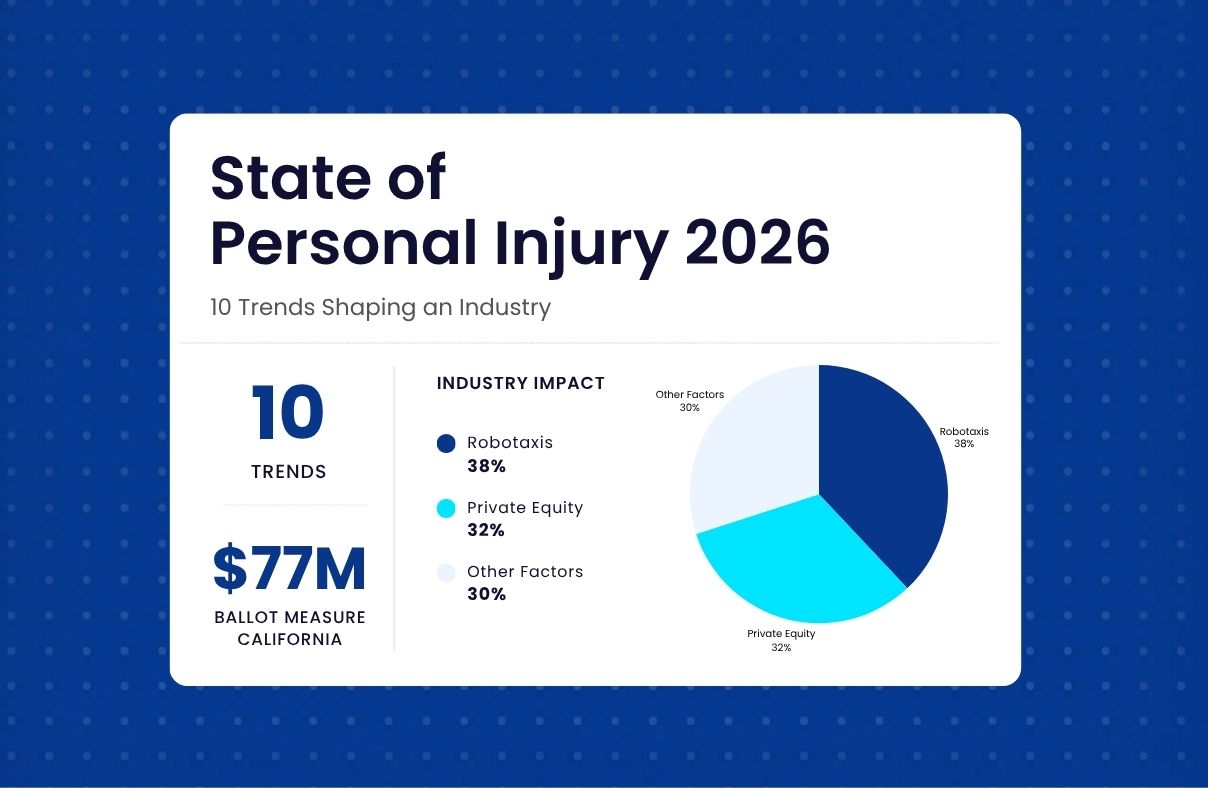
The personal injury world doesn’t change overnight. This year, it did.
In a few months, private equity started buying up injury firms, a single corporation put more than $77 million behind a California ballot measure to cap what your lawyer can charge, robotaxis became a real share of the cars on California roads, and courts started fining lawyers for citing cases that AI made up.
Most of this has unfolded in legislative committees and insurance trade reports rather than on the news. Here’s what’s shaping personal injury right now, and why each one matters if you’re a Californian who might get hurt and need to make a claim.
Private equity is buying personal injury firms
For most of American history, you couldn’t own a piece of a law firm unless you were a lawyer. That rule still exists in almost every state. Investors found a way around it.
The structure is called a management services organization, or MSO. The firm stays lawyer-owned on paper. A separate company, backed by private equity, buys everything that isn’t technically the practice of law: the marketing, the call center, the intake staff, the billing. Then it charges the firm management fees. The lawyers keep practicing. The investors collect.
Personal injury was the obvious first target. The U.S. personal injury law sector pulled in roughly $61.7 billion in 2025 across more than 64,000 firms, none of which held even 5% of the market. Lots of money, almost no consolidation, and clients won through billboards rather than any one attorney. That’s the profile private equity loves.
“Private equity buying PI firms (MSOs): If investors own your firm’s business side, there’s a risk that profit targets start shaping which cases get taken and how fast they’re pushed to settle, so the firm’s incentives may not line up perfectly with getting you the most money. The flip side is that well-funded firms can sometimes afford to fight longer and take cases a smaller shop would turn down.”
States are racing to ban the fee-sharing that makes those deals work
The legislative reaction has been fast and bipartisan. California moved first. A law effective January 1, 2026, bars California lawyers from sharing contingency fees with out-of-state structures owned or controlled by non-lawyers, with minimum fines of $10,000. A group of firms challenged it in federal court and lost their bid for an injunction in December 2025.
Illinois is working through a similar bill that cleared a House committee in March 2026, written broadly enough that one ethics lawyer warned it could end litigation finance in the state. Colorado’s version passed both chambers by wide margins in May 2026 and bans tying any MSO’s pay to a percentage of fees or case outcomes. The throughline: lawmakers want to lock in the principle that a lawyer’s judgment belongs to the client, not to whoever wrote the check.
The fight over who’s secretly funding lawsuits
There’s a parallel money story one layer down, in who funds the lawsuits themselves. Third-party litigation funding is when an outside investor pays for a lawsuit in exchange for a cut of the recovery. For years, it operated almost entirely in the dark.
That’s changing. New York passed a law, reworked and signed in early 2026, that caps a funder’s total take at 25% of the recovery, gives plaintiffs a ten-business-day window to cancel, and bars funders from steering strategy or settlement. A New York appeals court separately ruled, for the first time, that these funding agreements can be opened in discovery in an injury case.
At least seven states wrote new funding rules into law in 2025, Georgia among them, and a federal bill introduced in February 2026 by a bipartisan group of senators would force disclosure of funders, including foreign ones, in federal class actions and mass torts. The worry driving all of it: nobody in a courtroom currently knows who’s really steering a case from outside.
People trust injury lawyers more than they trust insurance companies
This one we measured directly. A national survey of 2,000 people DK Law commissioned in 2025 asked who’d perform better after an injury, a personal injury attorney or an insurance company. Attorneys won on every measure that matters: responsiveness, support, trustworthiness, and value.
The wider data explains why. The 2024 Edelman Trust Barometer scored property and casualty insurance in neutral-to-negative territory, with U.S. company scores flat or falling. A separate survey found 16% of people didn’t even consider insurance fraud wrong, some justifying it on the grounds that insurers rip customers off first.
After the killing of a major health-insurance CEO in late 2024, the public anger researchers documented online spilled well past health insurance into auto and home coverage. None of that means every adjuster acts in bad faith. It does mean the trust gap is real and measurable, and it shapes how people feel before they pick up the phone.
Robotaxis are changing what a car accident claim even looks like
Driverless cars stopped being a science project this year. Waymo raised $16 billion in February 2026 at a $126 billion valuation, runs more than 400,000 paid rides a week, and is pushing into new cities fast.
When a human rear-ends you, the claim is about that driver’s negligence. When the car has no driver, the question changes to whether the vehicle’s software or sensors failed, which turns it into a product liability claim against the manufacturer, a different and often larger category of recovery. California wrote new rules to match. A law effective July 1, 2026, holds manufacturers responsible when the autonomous system is engaged, sets up a dedicated line for first responders, and lets officials wall the cars out of emergency zones.
The safety picture is genuinely good, with Waymo reporting far fewer injury crashes per mile than human drivers. But “much safer” and “never at fault” aren’t the same thing. Regulators opened multiple investigations in 2025 and 2026, including one after a Waymo struck a child near a Santa Monica school, and the company recalled thousands of vehicles over a software issue. Regarding how these claims are actually handled, we wrote a full breakdown of what happens when a Waymo hits you.
Insurance fraud is following the money into no-fault states
In April 2026, federal prosecutors in Manhattan unsealed an indictment against a New York restaurateur for an auto insurance fraud scheme that allegedly ran tens of millions through shell medical clinics and laundered the proceeds through a Diamond District jewelry business.
The mechanics matter more than the spectacle. New York is a no-fault state, where your own insurer pays medical bills quickly without assigning blame, and patients can sign their right to reimbursement directly over to a provider. That direct billing channel is the vulnerability fraud rings exploit: set up a clinic, bill for treatment that never happened, and cash out before anyone checks. California works differently. It’s an at-fault state with no such direct-billing pool, so a crooked clinic can’t simply invoice an insurer and collect.
The risk here is inflated billing meant to pad a settlement, and the state already prosecutes it: California’s fraud investigators made 272 arrests and identified more than $207 million in potential losses in fiscal year 2023-24. That distinction matters because some reforms being sold to Californians aim at a problem the state’s system doesn’t have.
We unpacked that mismatch in what the New York fraud case reveals about California’s ballot initiative.
Uber is spending big to rewrite California’s injury rules
The most consequential thing on the horizon for California injury victims is a ballot measure. It’s titled the “Protecting Automobile Accident Victims from Attorney Self-Dealing Act,” and Uber has put more than $77 million behind it as the sole funder. It would cap attorney contingency fees at 25% in motor-vehicle cases, down from the usual third or more, and limit medical recovery by tying it to Medicare reimbursement rates rather than what the hospital actually charged. It would do this by amending the state constitution, so the legislature couldn’t touch it afterward.
Supporters frame it as protecting victims from predatory lawyers. The nonpartisan Legislative Analyst’s Office found a different likely outcome: fewer cases filed, and Medi-Cal costs rising by tens of millions of dollars a year as people who can’t recover through the courts fall back on public programs.
A Stanford law professor called the medical-expense language convoluted and warned that the fee cap functions as a price control on legal help. The capped fee would also have to cover litigation costs, which could make serious cases impossible to take. Uber has run this play before, spending around $200 million on Proposition 22 in 2020. The current measure still needs to qualify for the November 2026 ballot. We traced the company’s full history in this breakdown of the initiative.
Courts are sanctioning lawyers for AI that invents cases
Generative AI has a habit of fabricating things, and in law, that habit has consequences. A research database tracking the problem counted roughly 1,450 cases worldwide by mid-May 2026 in which AI-generated false citations made it into court filings, up from about 719 at the start of the year. The researcher running it described seeing ten such cases from ten different courts in a single day.
California issued its first published sanction in late 2025, fining a lawyer $10,000 after the court found 21 of 23 case quotations in his brief were fabricated, then referred him to the State Bar. He’d used several AI tools without checking their output. Bigger penalties have followed, including a roughly $110,000 sanction in Oregon and the first indefinite license suspension tied to AI fabrication.
This isn’t a ChatGPT problem specifically. One landmark sanction involved a different chatbot, and even legal-specific tools built on Westlaw and Lexis still invent facts somewhere between 17% and 34% of the time. The lesson for anyone tempted to run their own claim through a chatbot: it will sound confident and may be completely wrong. We’ve written more on whether AI can actually answer legal questions.
Nuclear verdicts are climbing, and so is the backlash
A “nuclear verdict” is shorthand for a jury award of over $10 million, and they’re getting bigger and more frequent. Los Angeles now sits at the top of the annual “judicial hellholes” list compiled by tort-reform advocates, driven by awards like a roughly $1 billion talc verdict in late 2025 and a $50 million verdict against a coffee chain over a spilled hot drink earlier that year.
The same report pegs excess tort costs nationally at around $367.8 billion a year, or a hidden “tort tax” of about $1,666 per American. Read those numbers with the source in mind, since the groups producing them want limits on lawsuits, and consumer attorneys dispute the framing. The underlying verdicts are real, though.
Buried in this fight is a technical question with big stakes: should a jury hear what a hospital billed, or only what was actually paid after insurance adjustments? The gap is often enormous. Georgia and Florida recently passed laws restricting recovery to amounts paid, and that exact mechanism, billed versus paid, is the same lever the Uber initiative pulls when it caps medical recovery at Medicare rates. Different vehicle, same fight.
Social inflation is quietly raising everyone’s premiums
The last trend ties several others together. Insurers call it social inflation: claim costs rising faster than ordinary inflation, pushed up by larger verdicts, litigation funding, advertising, and shifting juror attitudes. i.e., If normal inflation is 3% a year but the average injury claim costs insurers 8-10% more each year, that extra gap is “social inflation.”
The numbers are large. A joint analysis by the Insurance Information Institute and the Casualty Actuarial Society found legal-system factors added between $231.6 billion and $281.2 billion in liability insurance losses over the past decade, with personal auto liability alone accounting for as much as $102 billion. Auto-injury claim severity has risen far faster than general inflation, and commercial auto insurers have lost money on underwriting for more than a decade straight.
Attorney advertising feeds the cycle. Legal-services advertising ran to roughly $2.5 billion across nearly 27 million ads in 2024, with billboard spending alone up more than 250% since 2017. More ads bring more claims, larger awards reset what juries consider normal, and premiums climb for everyone, including careful drivers who never file a thing.
Where this leaves you
The thread running through all ten is that the rules around personal injury are being rewritten right now, by investors, insurers, tech companies, and legislators, often faster than the average person hears about it. Some of these changes might help. Several of the biggest, especially those marketed as consumer protection, would quietly make it harder for an ordinary injured person to be fully compensated.
You don’t need to track all of this. That’s our job. But if you take one thing from it: when something gets sold to you as protecting accident victims, ask who’s paying for the message and what they stand to gain.
If you’ve been hurt in California and want to make sense of where you stand, reach out for a free consultation. No cost, no pressure, and a real person who can tell you whether you have a case.
Attorney Expertise
15
Years of legal leadership under Daniel Kim, U.S. Army veteran and managing attorney.
Community Events
20+
Annual Turkey Drive, Fighters For You, and local safety initiatives that support our neighborhoods.
5-Star Reviews
5.0
A consistent record of exceptional service backed by real, vetted client reviews.
Why DK Law Makes a Difference
Attorney expertise, community impact, and proven results—three reasons clients trust us when everything is at stake.
Explore lo que más le importa
Buscando por ubicación o tipo de caso, le ayudaremos a llegar exactamente a donde necesita.
Ubique nuestra oficina más cercana.
Navegue por todas las ciudades y condados que atendemos. Vea en qué lugares nuestros abogados triunfan todos los días.

Explore las áreas de enfoque legal
Desde accidentes automovilísticos hasta demandas por muerte por negligencia, conozca todos los tipos de casos que manejamos con confianza.

DK All the Way


Desde su primer contacto hasta recibir su compensación, estamos con todos all the way.
Agende una consulta gratuita
Reciba asesoría legal experta sin ningún costo.
En DK Law estamos a su lado — all the way.
¡Agende hoy su consulta gratuita con nuestros expertos!

El tiempo es importante después de un accidente
Cuanto antes hables con un abogado después de un accidente, más sólido puede ser su reclamo. Actuar pronto ayuda a preservar la evidencia y a proteger sus derechos.
No ganamos, no cobramos | Disponible 24/7