


Car Injury Settlement Calculator | California
Estimate a California car injury claim, then learn what the available insurance may actually pay.
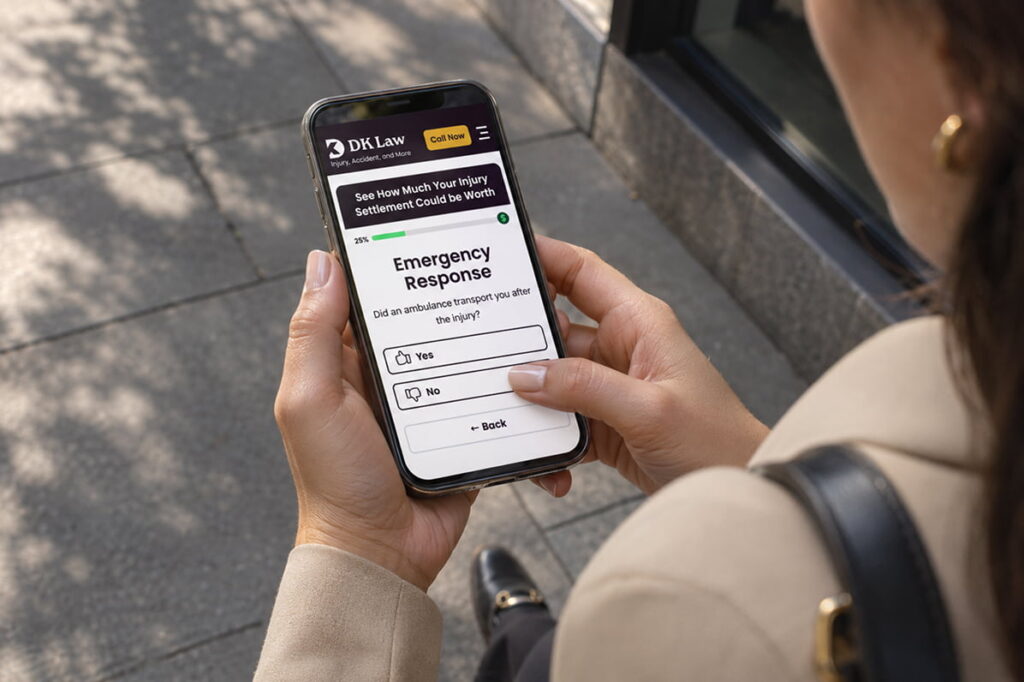
See How Much Your Injury Settlement Could be Worth
Get Started
What type of accident were you involved in?
Valid Auto Insurance
Did you have valid auto insurance at the time of the accident?
Emergency Response
Did an ambulance transport you after the injury?
Employment Details
What best describes your employment status at the time of the injury?
Economic Damages
Calculate your financial losses.
Pain & Suffering
Choose the option that best describes your injury and its impact.
Liability Assessment
Indicate how much of the accident you believe was your fault.
Not at fault
Your Estimated Settlement Value
Please note: This is only an estimate.
Estimated Total Compensation
$0
Economic Damages
Pain and Suffering
Itemized Calculation Breakdown
Economic Damages
Pain & Suffering
Liability Adjustment
This calculator provides only an estimate based on typical settlement formulas used in California personal injury cases. Every case is unique, and actual settlement values can vary significantly based on specific facts, evidence quality, insurance coverage, and negotiation dynamics. This tool is not legal advice. For an accurate evaluation of your case, please consult with a qualified California personal injury attorney.
What a car injury claim is worth and what it can actually collect are two separate questions. The calculator answers the first one. The sections underneath answer the second, which in California comes down to whose policy applies, how much coverage exists on it, and whether you were insured yourself on the day of the crash.
Key Takeaways
- California drivers have carried at least $30,000 per person and $60,000 per accident in bodily injury coverage since January 1, 2025. Those figures will rise again in 2035.
- The $60,000 per accident figure is shared among everyone hurt in the same crash, not paid to each person.
- Underinsured motorist coverage on your own policy fills part of the gap when the at-fault driver's limit runs out.
- Drivers who were uninsured at the time of the crash cannot recover pain and suffering damages, even when someone else caused it.
- You have two years to file against a private driver and six months to file a claim against a public entity.
Who actually pays after a California crash
The at fault driver's liability insurer pays first, and in most crashes, it is the only payer. California runs an at fault system, so there is no personal injury protection benefit that pays your medical bills regardless of blame.
Beyond that first policy, four other sources show up often enough to be worth checking before settling anything.
- Your own MedPay coverage, if you bought it, pays medical bills up to its limit without regard to fault.
- Your uninsured or underinsured motorist coverage, which steps in when the other driver had nothing or had too little.
- A commercial or employer policy, if the at fault driver was working. Commercial limits are usually several multiples of a personal policy.
- A rideshare policy, which carries a $1 million liability limit while a driver is on an active trip.
A fifth possibility is the vehicle's owner, when that is a different person from the driver. California caps a permissive use owner's liability at $15,000 for one injury and $30,000 for one accident, a figure that was never raised alongside the minimum coverage increase.
California's minimum insurance limits, and what changes in 2035
Since January 1, 2025, the minimum a California driver must carry is $30,000 for injury or death to one person, $60,000 per accident, and $15,000 for property damage. The previous minimums had been 15/30/5 since 1967.
Those minimums go up again on January 1, 2035, to $50,000 per person, $100,000 per accident, and $25,000 for property damage.
The per accident figure is the one that catches people. A $60,000 per accident limit is not $60,000 for each injured person. It is $60,000 divided among everyone hurt in that crash, which means a three-person injury claim against a minimum limits policy is competing for the same money.
What happens when your damages are bigger than the other driver's policy
A liability insurer does not pay past the policy limit. If your documented damages come to $140,000 and the at-fault driver carries the minimum, the liability payment stops at $30,000 and the remaining $110,000 has to come from somewhere else or go uncollected.
Underinsured motorist coverage on your own policy is the usual answer. California defines an underinsured vehicle as one whose liability limits are lower than your UIM limits, and under the uninsured motorist statute, the UIM insurer's exposure is its limit less what the liability insurer already paid.
That subtraction is why UIM disappoints people. If you carry $100,000 in UIM and the at fault driver's insurer pays $30,000; your UIM claim is worth up to $70,000, not $100,000. Carrying UIM at the same limit as the other driver's liability coverage produces nothing at all.
Pursuing a driver's personal assets is possible and rarely productive. Most people with minimum limit policies do not have recoverable assets, and a judgment that cannot be collected is paperwork.
Were you uninsured when the crash happened?
If you were driving your own uninsured vehicle, Proposition 213 bars you from recovering non-economic damages even when the other driver was entirely at fault. Pain, suffering, physical impairment, disfigurement: all of it is off the table. Medical bills and lost wages still are not.
On a claim where most of the value sits in non-economic damages, which describes most soft tissue claims, this removes the majority of the case.
Three situations fall outside the bar. It does not apply if the at fault driver was convicted of driving under the influence arising from that crash, and it does not apply to passengers, who are not required to insure anything.
The third came from the California Supreme Court. Hodges v. Superior Court held that the bar does not reach a product liability claim against a vehicle manufacturer, because that claim does not arise from the operation or use of the vehicle in the way the statute means.
Check the insurance box in the calculator. An estimate built on coverage you did not have is not an estimate.
Does minor vehicle damage lower an injury claim?
Nothing in California law ties injury damages to repair cost. Damages are measured by the harm to the person, and a bumper that absorbed the impact well is not evidence that a neck did.
In practice, low property damage gets used as an argument anyway, and it is an argument worth preparing for rather than dismissing. Claims involving minor vehicle damage and soft tissue complaints have historically been routed into separate handling programs built around that correlation.
What answers it is the medical record. A documented mechanism of injury, an early diagnosis, consistent treatment, and a physician willing to state the connection carry more weight than photographs of a car do. Speed and damage also correlate loosely at best, since a low-speed rear impact transfers force differently depending on head restraint position, seat design, and whether the occupant saw it coming.
How fault splits the payout in California
California uses pure comparative fault, which means your damages are reduced by your percentage of responsibility, and the claim survives at any percentage. Found 30% at fault on a $100,000 claim and you recover $70,000. Found 80% at fault and you recover $20,000.
No threshold cuts you off. States using modified comparative fault bar recovery entirely once a plaintiff crosses 50% or 51%, and California rejected that approach in 1975.
Fault percentages are negotiated, not assigned by any neutral party during a claim. A police report's opinion about fault carries weight with an adjuster but is not binding, and traffic collision reports are generally inadmissible at trial.
How long you have to file a car injury claim
Two years from the date of the crash, under Code of Civil Procedure section 335.1. Miss it and the claim is over regardless of how clear the liability was.
Claims against a public entity run on a far shorter clock. If a city bus, a county vehicle, or a dangerous road condition is involved, you must present a written claim to that entity within six months before a lawsuit is possible. That deadline catches people who spent the first several months focused on treatment.
Minors get more time, since the two year period generally does not start running until the eighteenth birthday.
Crash injuries in Los Angeles and Orange County
Los Angeles County recorded 58,758 people killed or injured in traffic collisions in 2023, with 12,319 fatal and injury collisions involving speed. Orange County recorded 17,809 killed or injured across the same year, with 4,062 speed related fatal and injury collisions.
Both figures come from the Office of Traffic Safety, which compiles them from the Statewide Integrated Traffic Records System. Neither number says anything about what individual claims settle for, and no California agency publishes settlement data by county.
Common questions
Is $50,000 a good settlement for a car accident? It depends on two things: what the documented damages are, and how much coverage exists. A $50,000 offer on a claim with $8,000 in paid medical bills and a full recovery is strong. The same offer on a surgical claim against a $100,000 policy is not.
How much of a $30,000 settlement will I get? Subtract the attorney fee, then case costs, then medical liens. The $30,000 figure appears often because it matches California's minimum per person limit, which means it is frequently a policy limits tender rather than a valuation of the claim.
What if the other driver fled? A hit and run is handled through your uninsured motorist coverage. California requires physical contact with the unidentified vehicle for an uninsured motorist claim, so a witness statement describing a car that caused a crash without touching you creates a problem.
Does my own insurance rate go up if I make a claim? Not for a crash where you were not at fault. California prohibits surcharging a policyholder based on a not at-fault accident.
Should I give the other driver's insurer a recorded statement? You are not obligated to. Your own policy generally requires cooperation with your insurer. The other driver's insurer has no such claim on you.
Get a read on your own numbers
The calculator gives you a range. Where your claim falls inside it comes down to what your medical records document about function, whether treatment escalated, and what coverage is available, and those are questions worth putting to someone who reviews these files daily.
DK Law handles back and spinal injury claims throughout California. Call 800-719-9779 for a free consultation or request a case evaluation. No cost unless we recover for you.
Explore By What Matters Most
Whether you're searching by location or case type, we'll help you get exactly where you need to be.
Find Us Near You
Browse all cities and counties we serve.
See where our attorneys are winning cases every day.

Explore Legal Focus Areas
From car accidents to wrongful death, see every type of case we handle with confidence.

DK all the way
From Your Case to Compensation, we take your case all the way.
Schedule a Free Consultation
Get Expert Legal Advice at Zero Cost.
At DK Law we're with you - all the way.
Get a Free Consultation with our experts today!

Time Matters After an Accident
The sooner you speak with an attorney after an accident, the stronger your claim can be. Early action helps preserve evidence and protect your rights.
No Win No Fee | Available 24×7