


Whiplash Settlement Calculator
Estimate your whiplash claim in seconds, then find out how injury grade, imaging, treatment, and policy limits shape your final number.
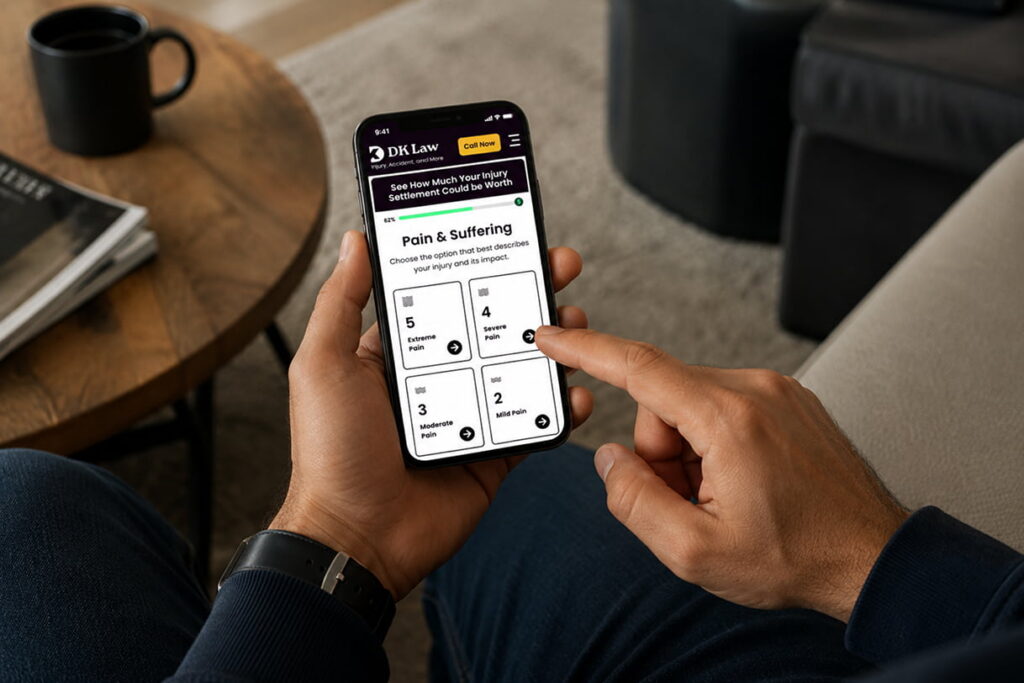
See How Much Your Injury Settlement Could be Worth
Get Started
What type of accident were you involved in?
Valid Auto Insurance
Did you have valid auto insurance at the time of the accident?
Emergency Response
Did an ambulance transport you after the injury?
Employment Details
What best describes your employment status at the time of the injury?
Economic Damages
Calculate your financial losses.
Pain & Suffering
Choose the option that best describes your injury and its impact.
Liability Assessment
Indicate how much of the accident you believe was your fault.
Not at fault
Your Estimated Settlement Value
Please note: This is only an estimate.
Estimated Total Compensation
$0
Economic Damages
Pain and Suffering
Itemized Calculation Breakdown
Economic Damages
Pain & Suffering
Liability Adjustment
This calculator provides only an estimate based on typical settlement formulas used in California personal injury cases. Every case is unique, and actual settlement values can vary significantly based on specific facts, evidence quality, insurance coverage, and negotiation dynamics. This tool is not legal advice. For an accurate evaluation of your case, please consult with a qualified California personal injury attorney.
This whiplash settlement calculator starts with your documented losses. What follows is the part a calculator cannot do: the specific things that decide whether a neck injury claim closes at $8,000 or $80,000.
Key Takeaways
- No public dataset reports average whiplash settlements. Neither the federal government nor any peer-reviewed source publishes settlement values broken out by diagnosis, which is why the ranges you see quoted across the web trace back to other law firm pages rather than to any original data.
- Whiplash is graded clinically on a five-point scale, and Grades I and II are defined by the absence of imaging findings. A clean MRI is the expected result in most legitimate whiplash claims, not evidence that nothing happened.
- About half of people fully recover from a whiplash injury, a quarter develop persistent moderate to severe pain, and a quarter land somewhere in between. Initial pain intensity predicts which group you fall into better than any other early measure.
- The at-fault driver's policy limit sets the practical ceiling on most neck injury claims. California's minimum bodily injury coverage is $30,000 per person and $60,000 per accident, and a claim worth more than the policy usually still closes at the policy.
- California drivers who were uninsured at the time of the crash cannot recover pain and suffering at all, which removes the largest component of a typical whiplash claim.
How is a whiplash settlement calculated?
A whiplash settlement starts with your economic damages, meaning the losses you can document with paper: emergency care, imaging, physical therapy, prescriptions, mileage to appointments, and the wages you lost while you could not turn your head. Those numbers are added up. Then a second, softer figure gets attached for pain and suffering.
That second figure is where the arithmetic stops being arithmetic. The common shorthand is to multiply economic damages by somewhere between 1.5 and 5, which is how our main injury settlement calculator estimates the number.
No statute, regulation, court opinion, or insurance industry publication establishes that multiplier as a standard. It is typically done between lawyers and insurance companies during the settlement process. That’s why payouts may vary.
So the useful question is not what formula an adjuster runs. It is what evidence exists in your file, because the evidence is what determines which end of any range you land on.
What are the whiplash injury grades?
Whiplash is classified on a five-grade scale developed by the Quebec Task Force and published in Spine in 1995. The grades describe what a clinician can actually find on examination:
- Grade 0. No neck complaint and no physical signs.
- Grade I. Neck pain, stiffness, or tenderness only. No physical signs on exam.
- Grade II. Neck complaint plus musculoskeletal signs, typically reduced range of motion and point tenderness.
- Grade III. Neck complaint plus neurological signs. Weakness, sensory loss, or diminished reflexes.
- Grade IV. Neck complaint plus fracture or dislocation.
Grades III and IV are classified in the medical literature as traumatic cervical spinal injury rather than soft tissue injury, and they behave differently in a claim because the injury is visible on imaging. Grades I and II are the ones people mean when they say whiplash, and they make up the large majority of neck injury claims after a rear-end collision.
Knowing your grade is more useful than knowing a dollar range. It tells you what an adjuster can and cannot dispute about your file.
Does a normal MRI mean you don't have whiplash?
No. Grades I and II are defined by normal imaging. Cervical sprain is described in the clinical literature as a diagnosis of exclusion, meaning the diagnosis is made after a workup finds no structural pathology. The injured structures in a Grade I or II case are facet joint capsules, small muscles, and nerve fibers, all of which sit at or below the resolution of an X-ray, CT, or MRI.
This is the most common argument raised against neck injury claimants, and it only works if nobody explains the grading system. A 2024 prospective study of 129 patients with acute Grade II whiplash found signs of nerve pathology in 65% of them, with about a quarter still showing measurable sensory loss at six months. The pathology was detectable. It just required quantitative sensory testing rather than a scan.
What substitutes for imaging in a Grade I or II file: documented range-of-motion measurements taken at more than one visit, a treating physician's functional restrictions, and a consistent record that tracks symptoms over time rather than asserting them once.
What actually changes the value of a neck injury claim
Four things, roughly in order of weight.
Documented functional loss. Not pain scores. What you could not do, for how long, recorded by someone with credentials. A physical therapist's discharge summary noting a 30-degree rotation deficit at week eight carries more weight than eight weeks of visit notes that all say "patient reports neck pain."
Recovery trajectory. A study in the journal Pain put it at roughly half of people recovering fully, about a quarter developing persistent moderate to severe pain and disability, and the remaining quarter landing in milder territory. High pain intensity in the first weeks is the strongest early predictor of the bad outcome. A file that shows worsening or plateaued function at three months describes a different injury than one showing steady improvement.
Treatment continuity. Gaps get used against claimants. Here is the honest version, though: no primary or academic source establishes that a treatment gap reduces claim value by any measurable amount. It is a negotiating position, not a rule. It works because it is hard to rebut, which is a reason to keep appointments rather than a reason to accept the argument.
Crash mechanics. Minor vehicle damage gets offered as proof of minor injury. NHTSA regulates head restraints specifically because rear-impact neck injury is common, and its October 2023 evaluation measured an 11.1% reduction in cervical spine injury in vehicles with upgraded restraints. The same analysis found female occupants were more likely than male occupants to sustain cervical spine injuries in rear-end crashes. Bumper damage is not a proxy for occupant injury.
One thing that does not predict a worse outcome, despite being raised constantly: a 2003 systematic review of prospective cohort studies found no association between filing a compensation claim and poor recovery, and no association with age or gender either.
Why the policy limit usually matters more than the injury
For most ordinary neck injury claims, the number that controls the outcome is not on your medical chart. It is on the at-fault driver's declarations page.
We track publicly reported settlements across the country, and the clearest illustration of this sits in a different category. Among the 62 cases in our 2026 settlement tracker, eight were dog bite claims, and six of them closed between $300,000 and $310,000. One was confirmed as the exact homeowner's policy limit. Six injuries of varying severity, six nearly identical outcomes. The policy set the number.
Neck injury claims work the same way at the lower end. If the driver who hit you carries California's minimum bodily injury coverage, currently $30,000 per person and $60,000 per accident, then $30,000 is the practical ceiling on a claim against that policy no matter what your file supports. Collecting past a policy limit happens, but it is uncommon.
Which is why the useful early question is what coverage exists. Your own underinsured motorist coverage, a commercial policy if the other driver was working, an employer's policy under vicarious liability. Those change the ceiling. Your MRI does not.
What real neck injury settlements look like
Published settlements skew high, because a $9,000 soft tissue claim never makes the news. With that caveat stated, here are neck and rear-impact cases from our 2026 tracker, each one a real reported outcome rather than a projection:
- A Maryland nurse with a soft tissue injury from a car crash recovered $85,000.
- A Long Island passenger injured in a bus rear-end collision recovered $900,000.
- A Missouri claimant in a rear-end chain collision recovered $155,000.
- A Florida claimant who required neck surgery after a semi-truck intersection crash recovered $2.75 million.
The spread between the first and last case is not explained by how much either person's neck hurt. It is explained by surgery, by defendant type, and by available coverage. The commercial truck case involved a corporate defendant, and corporate defendants across our full dataset paid a median of $1.89 million against $300,000 for individual defendants.
We do not publish an average whiplash settlement figure, and we will not, because the number would be invented. Anyone quoting one is either using their own closed-case data or repeating a figure with no origin.
How California law changes a whiplash claim
Three provisions do most of the work.
You have two years from the date of the crash to file a personal injury lawsuit. Miss it and the claim ends regardless of merit.
If you were driving without valid insurance at the time, Proposition 213 bars you from recovering non-economic damages even when the other driver caused the crash entirely. On a whiplash claim, that removes the largest component of the value. Medical bills and lost wages remain recoverable.
Partial fault reduces recovery but never eliminates it. California uses pure comparative negligence, so a claimant found 40% responsible still recovers 60%.
One procedural point worth knowing: California's claims regulations require an insurer to acknowledge a claim and begin investigating within 15 calendar days of notice, and to accept or deny within 40 days of receiving proof of claim. Silence past those windows is not normal, and documenting it matters.
There is no California deadline requiring you to obtain medical treatment within any set period after a crash. The 14-day treatment rule people cite is Florida's no-fault statute and does not apply here. Delaying care makes a claim harder to prove. It does not forfeit it.
Frequently asked questions
Is Grade 2 whiplash serious? Grade II means a clinician found objective musculoskeletal signs, typically reduced range of motion and point tenderness, alongside your reported pain. It is the most common grade in claims, and it is genuinely injurious, though it does not involve nerve damage or fracture. Roughly a quarter of whiplash patients across all grades develop lasting moderate to severe symptoms, so a Grade II diagnosis does not predict a quick recovery on its own.
What is the average payout for a Grade 3 whiplash injury? No credible source publishes payout figures by whiplash grade. Grade III involves neurological findings such as weakness or sensory loss, which usually means imaging and specialist referral, and files with objective neurological evidence are harder to dispute than Grade I or II files. That changes negotiating position. It does not produce a predictable number.
What is the standard insurance payout for whiplash? There is no standard. The two variables that most often set the outcome are whether treatment escalated beyond conservative care and how much liability coverage exists.
Does going to a chiropractor hurt my claim? Chiropractic care is legitimate treatment and appears in a large share of whiplash files. What matters more than the provider type is whether the record documents functional change over time and whether a physician has weighed in on restrictions and prognosis.
Talk through your numbers with someone
The calculator gives you a starting range. Whether your file supports the top or the bottom of it depends on what your records actually show and what coverage is available, and those are both things a person can assess in a short phone call.
DK Law handles neck and spine injury claims across California. Call 800-719-9779 for a free consultation, or request a case evaluation. There is no cost unless we recover for you.
Explore By What Matters Most
Whether you're searching by location or case type, we'll help you get exactly where you need to be.
Find Us Near You
Browse all cities and counties we serve.
See where our attorneys are winning cases every day.

Explore Legal Focus Areas
From car accidents to wrongful death, see every type of case we handle with confidence.

DK all the way
From Your Case to Compensation, we take your case all the way.
Schedule a Free Consultation
Get Expert Legal Advice at Zero Cost.
At DK Law we're with you - all the way.
Get a Free Consultation with our experts today!

Time Matters After an Accident
The sooner you speak with an attorney after an accident, the stronger your claim can be. Early action helps preserve evidence and protect your rights.
No Win No Fee | Available 24×7