


What happens when a car accident claim exceeds insurance limits in California?
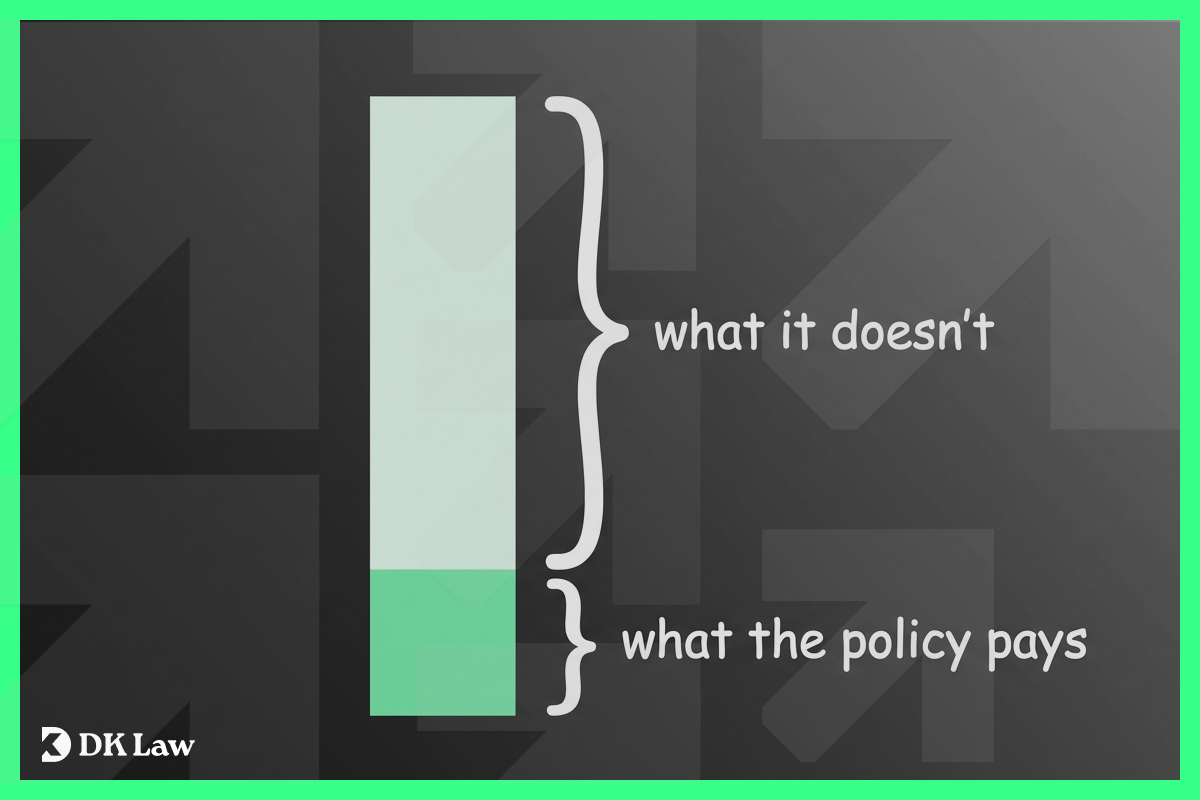
The math is usually simple and awful. Your medical bills come to $180,000. The driver who hit you carried $30,000 in bodily injury coverage. His insurance company sends a letter offering the full $30,000, which reads as generous until you look at the first number again.
California requires drivers to carry very little. The gap between what the law demands and what a serious injury actually costs is where most car accident claims end up, and what happens next follows a fairly predictable sequence. Two points in that sequence are permanent once you pass them.
Key Takeaways
- An insurer pays up to the policy limit and stops. The remainder becomes the at-fault driver’s personal debt, which is a different thing from money you can collect.
- California’s minimum liability coverage rose to 30/60/15 for policies issued or renewed on or after January 1, 2025. The previous minimums had been unchanged since 1967.
- A policy limits check arrives attached to a release. Signing it ends your claim against the driver and against his insurer.
- The bad faith claim against an insurer that refused a reasonable settlement belongs to the at-fault driver, not to you. It reaches you only if he assigns it.
- When several people are hurt in one crash, they compete for one aggregate limit, and the insurer can ask a court to divide it.
What does it mean for a claim to exceed policy limits?
Every liability policy has two ceilings. One caps what the insurer will pay any single injured person. The other, higher, caps what it will pay everyone hurt in the same accident. A policy written at 30/60 pays a maximum of $30,000 to one person and $60,000 across all claimants, whatever the injuries actually cost.
Once damages run past that ceiling, the insurer’s obligation ends. Your losses are not capped at the same number, though. The difference becomes the at-fault driver’s personal liability and can be reduced to a judgment against him. Whether that judgment is worth anything depends on what he owns.
This is the general rule anywhere auto claims run through fault-based liability rather than a no-fault system. California is a pure-fault state and offers no personal injury protection product, so there is no first-party medical benefit sitting underneath the liability policy to absorb the overflow.
What are California’s minimum limits now?
For fifty-eight years, the answer was $15,000. That changed with Vehicle Code section 16056, which now requires any policy issued or renewed on or after January 1, 2025 to carry at least $30,000 for injury to one person, $60,000 for everyone injured in one accident, and $15,000 for property damage. The old figures, 15/30/5, had been in place since 1967.
The increase matters less than it sounds. An ambulance ride, an emergency room visit, and a CT scan can clear $30,000 before anyone mentions surgery. Doubling the floor moved it from wildly inadequate to inadequate.
Which is why a claim exceeding the limits is the ordinary case rather than the exotic one. It is the expected result any time a crash produces a real injury, and the at-fault driver bought the cheapest policy available. A further increase is already written into the statute for policies issued or renewed on or after January 1, 2035.
What does the insurer do once it sees the claim is bigger than the policy?
It usually moves fast, for reasons that have nothing to do with you.
An insurer that unreasonably turns down a settlement offer inside the policy limits, then watches a jury return a verdict above them, can in some cases be held responsible for the entire judgment rather than just the policy amount.
So the adjuster does the arithmetic. If your documented damages clearly exceed the limit and liability is not seriously contested, paying the full limit early costs the insurer nothing it was not already going to lose, and it closes the file before anyone starts looking elsewhere for coverage. How that offer is framed, and what a response should do with it, is covered in our piece on responding to an insurance settlement offer.
So a quick, unprompted, full-limits offer is information. It generally means the adjuster has valued your case well above what the policy can pay.
Why does the fast policy limits offer deserve a slow answer?
The check does not arrive alone.
A standard release ends your claim against the driver personally, not only against his insurance company. Most releases also waive Civil Code section 1542, the provision that would otherwise preserve claims you do not yet know you have. Waive it, and a herniation that surfaces in month four is covered by a signature from month one.
The costlier problem takes three steps to see.
Step one. California does not let you sue the other driver’s insurer over how it treated you. That claim does not exist here.
Step two. The driver can sue them over how they treated him. If the insurer passed up a reasonable chance to settle inside the policy and a jury later returned $200,000, he is personally responsible for the $170,000 his own insurance company could have prevented. That is a wrong done to him.
Step three. He can hand that claim to you. The usual trade is a promise that nobody comes after his house or his paycheck.
So money above the limit is sometimes reachable, but only through the driver, and only if he actually got stuck with the debt. A release breaks step two. Sign it, and he is never stuck with anything, so there is no wrong, no claim, and nothing left to hand over. The document that pays you $30,000 is the same one that closes the only route to more.
In most cases, nothing is lost, because the insurer tendered promptly and $30,000 was always the ceiling. Having someone read the release first costs nothing. Signing it cannot be undone.
Who actually owns the bad faith claim?
California eliminated the injured person’s direct claim against the other side’s insurer in 1988. Moradi-Shalal v. Fireman’s Fund held that Insurance Code section 790.03, the statute cataloging unfair claims practices, gives a third-party claimant no private right of action. You cannot sue the driver’s insurance company for handling your claim badly. That lawsuit does not exist.
What exists is a duty the insurer owes its own policyholder. It has to give the policyholder’s interests real weight when a reasonable within-limits offer is on the table, and it answers to him if it does not. When it refuses and a jury awards more than the policy, the driver is the one holding a claim, because the driver is the one personally liable for a judgment his insurer could have prevented.
That claim is assignable. In practice, the driver assigns it in exchange for a promise that nobody will collect the judgment out of his own pocket, an arrangement California courts have permitted.
Which produces something strange about these cases. On this one question, you and the person who hit you want the same outcome. He wants out from under an excess judgment. You want a defendant who can pay. His insurer is across the table from both of you.
What if several people were hurt in the same crash?
The per-accident number is what hurts here. Four people injured, one policy written at 30/60, and the insurer’s total exposure is $60,000 for everyone. Divided evenly, that is $15,000 apiece, and nobody’s injuries were priced with an even split in mind.
Insurers handle this by depositing the limit with a court and letting the claimants argue over it. Once the money is interpleaded, the insurer steps out, and the court divides the fund.
Two things follow. Timing matters, because a claimant who settles early and separately can take a disproportionate share before the fund is ever deposited. And documentation matters more than usual, because allocation turns on relative severity, and the person with the thinner medical file loses ground to the person with the thicker one.
How much of a capped settlement actually reaches you?
When the pot is fixed, the only remaining variable is what comes out of it first.
A hospital that treated you can assert a lien, and under the Hospital Lien Act that lien is limited to half of what remains after prior liens are paid. A real limit, still half. If Medi-Cal paid, its recovery is reduced by twenty-five percent for attorney’s fees and is supposed to reach only the portion of the settlement attributable to past medical expenses.
On a $30,000 recovery against $180,000 in bills, lien negotiation stops being an administrative step. It becomes the last available lever on what actually lands in your account, and the difference between doing that work carefully and not doing it can be most of the settlement. Our guide to how liens get resolved out of settlement proceeds walks through the order of operations.
Can you collect from the driver personally?
Sometimes. Rarely much.
A judgment reaches wages, bank accounts, and non-exempt property, and California will suspend a judgment debtor’s license if thirty days pass without payment. That is pressure rather than money. Someone who carries minimum limits often does so because that is what he could afford, and state exemptions protect a meaningful share of what he does own.
We covered the realistic version of this in what happens when you sue someone with no money.
Where does the money usually come from instead?
Recovery above the limits, when it happens, almost never comes out of the at-fault driver’s pocket. It comes from a second policy or a second defendant. Your own underinsured motorist coverage. His employer, if he was working. A rideshare company’s commercial policy. A public entity that maintained the road badly. An umbrella policy sitting above his auto policy that nobody volunteered.
Locating those is a separate exercise with its own rules, and California makes it harder than most states, because nothing obligates the other side’s insurer to tell you what coverage exists before you file suit.
We mapped that process in how to get more than policy limits in a California settlement.
Common questions
Does exceeding the policy limits mean I will recover more? No. It means the additional money has to come from somewhere other than that policy, and sometimes there is nowhere for it to come from.
How long do I have to act? Two years from the crash for most injury claims in California. Six months to present a claim if a public entity is involved, which is the deadline people miss.
What happens if someone sues me for more than my insurance covers? Your insurer defends you and pays to the limit, and you are personally exposed above it. DK Law represents injured people rather than at-fault drivers, so this is a question for defense counsel, which your policy generally requires your insurer to provide.
Should I sign the release the insurance company sent? Not before someone reads it against the rest of your case. The release is where the terms live, and the settlement amount is only one of them.
Talk to someone before the deadline runs
If your bills have already passed the other driver’s coverage, the useful question is not whether the policy is too small. It is which other policies and defendants exist, and whether anything you have been asked to sign would close the door on them. Contact DK Law for a free consultation.
Prior results do not guarantee or predict a similar outcome in any future case. Attorney Advertising. DK Law, Costa Mesa, CA.
DK All the way


From Your Case to Compensation, we take your case all the way.
Schedule a Free Consultation
Get Expert Legal Advice at Zero Cost.
At DK Law we’re with you – all the way.
Get a Free Consultation with our experts today!

Time Matters After an Accident
The sooner you speak with an attorney after an accident, the stronger your claim can be. Early action helps preserve evidence and protect your rights.
No Win No Fee | Available 24×7