


Car Crash Head Injury: What Happens Next
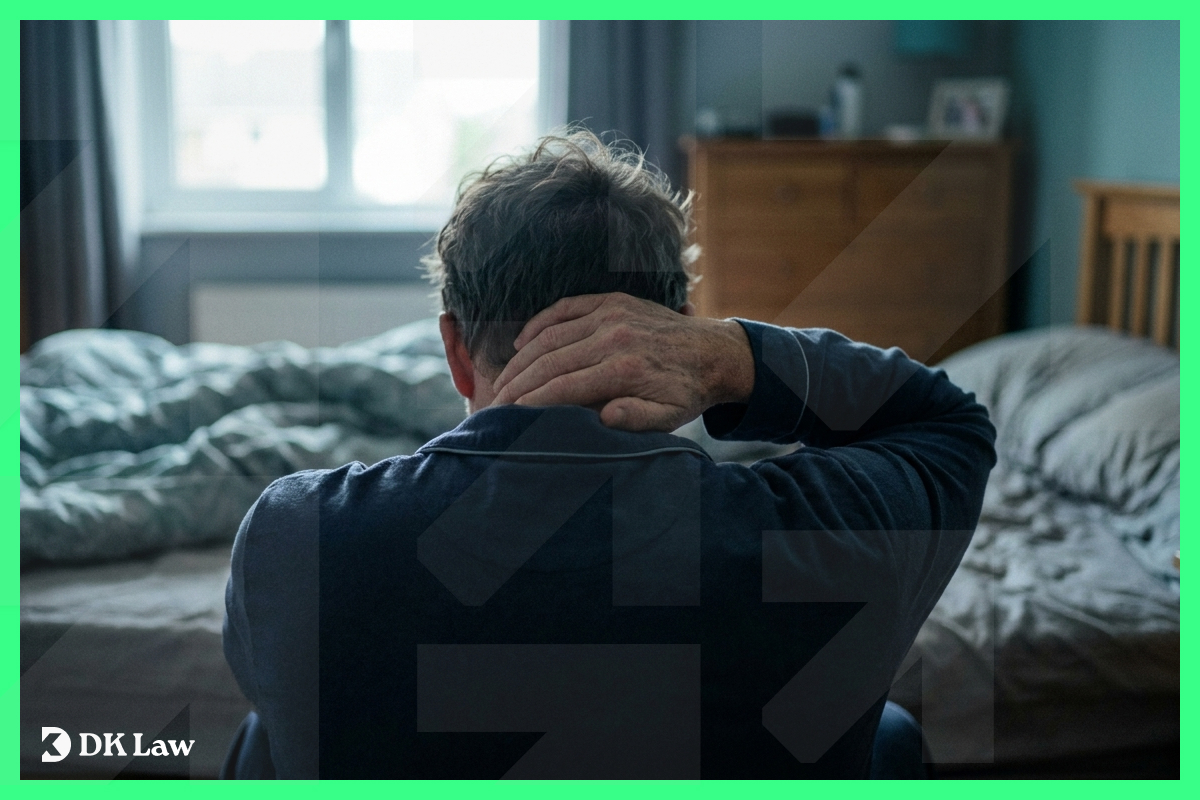
A car crash head injury can be anything from a concussion you barely notice at the scene to bleeding inside the skull that turns dangerous within hours. The two can look identical in the first minutes after a crash. You walk away, you feel shaken but okay, and three days later the headaches won’t stop, and you can’t remember why you walked into the kitchen.
That gap, between how you feel right after and what’s actually happening in your brain, is the whole reason head injuries get missed, undertreated, and undervalued when it comes time to deal with the insurance company.
Here’s what happens next, from the emergency room through your claim, and what California law gives you to deal with it:
| Stage | What’s happening | Rough timeframe |
| Right after the crash | Emergency evaluation, imaging if warranted, first diagnosis. The record starts here. | Day of the crash |
| Early treatment | Follow-ups, referrals to neurology, symptom tracking. Whether symptoms fade or persist starts to become clear. | First weeks |
| Reaching maximum medical improvement | Your condition stabilizes enough that doctors can describe your prognosis and any lasting effects. Settling before this point is risky. | Months, sometimes longer for severe TBI |
| Demand and negotiation | Once the picture is clear, a demand goes out and negotiation begins. | After improvement plateaus |
| Lawsuit, if needed | Filed if negotiation stalls, and it must happen inside the two-year deadline regardless of where treatment stands. | Within 2 years of injury |
These are general ranges, not a schedule. Your own timeline depends on the injury, the treatment, and how the insurer behaves.
What actually happens to your brain in a crash
Your brain floats inside your skull, cushioned by fluid. In a crash, it keeps moving after your head stops, slamming forward and back, sometimes rotating. That movement alone can injure the brain even if your head never hits the window or the wheel. The damage comes in a few recognizable forms.
| Injury type | What causes it | Often shows on a CT scan? |
|---|---|---|
| Concussion (mild TBI) | A jolt, blow, or whiplash motion that briefly disrupts how the brain works. The most common crash brain injury. | No |
| Contusion | A bruise on the brain itself, with localized bleeding and swelling. | Usually |
| Coup-contrecoup | Bruising both where the impact hit and on the opposite side, as the brain rebounds into the far wall of the skull. | Usually |
| Diffuse axonal injury (DAI) | The brain’s long nerve fibers tear from rotational force. One of the most common and serious features of TBI, and characteristically caused by the acceleration and rotation of a car crash. | Often not |
| Hematoma (subdural/epidural) | Bleeding between the brain and skull. Can be life-threatening and can develop in a delayed way. | Usually |
Two things on that table matter later when you’re dealing with insurance. The two most common crash injuries, concussion and DAI, are also the two least likely to show up on a standard CT scan. A “normal” scan does not mean your brain is fine. And DAI is not some exotic injury. It comes from the exact rotational forces a collision produces, which is why it shows up so often in car crash cases and so rarely in the insurance company’s version of events.
Doctors grade brain injuries as mild, moderate, or severe, usually starting with the Glasgow Coma Scale, a 3-to-15 score based on eye, verbal, and motor responses. A “mild” score and a wrecked year are completely compatible, so it’s useful shorthand for an ER and much weaker as a prediction of how you’ll actually do. Motor-vehicle crashes are one of the leading causes of TBI-related hospitalization in the country, second only to falls.
Why head injury symptoms show up days later
Adrenaline floods your system in a crash and masks pain and confusion for hours. Underneath it, a brain injury can set off a slow chain of chemical changes, swelling, and in some cases bleeding that builds gradually. A subdural hematoma in particular can leak slowly enough that you feel normal at first and get worse over a day or two.
Symptoms to watch for in the days after a crash:
- Headache that gets worse instead of better
- Repeated vomiting or nausea
- Worsening confusion, trouble concentrating, or memory gaps
- Dizziness, balance problems, or sensitivity to light and noise
- Sleep changes, mood swings, irritability that wasn’t there before
- Any weakness or numbness, slurred speech, or seizures, which are emergencies, call 911
The delay is a medical danger. It’s also the thing insurance adjusters lean on hardest. If you didn’t go to the doctor right away, and the symptoms showed up later, they’ll argue the two aren’t connected. Which points to the single most useful thing you can do for both your health and your claim: get checked out even if you feel okay, and tell the doctor about every symptom so it’s in the record from day one.
What is the 4-hour rule for a head injury?
The “4-hour rule” isn’t an American law and it isn’t a deadline for you to do anything. It comes from the United Kingdom’s NICE head injury guidance, which tells emergency clinicians to observe a patient with certain risk factors for at least four hours, and to run a CT scan within the hour if the patient’s condition drops during that window.
It’s an emergency-medicine protocol, not a rule that governs your case. US hospitals use their own decision tools to decide who needs a scan and how long to watch them. The reason the idea has stuck around is sound: dangerous bleeding can show up hours after someone arrives looking fine, so a period of observation catches problems a single snapshot at intake would miss. If you’re sent home after a head injury, that’s the logic behind the instructions to have someone stay with you and watch for the symptoms above.
How a brain injury changes what your claim is worth
Most car accident injuries get run through a formula. Insurers take your medical bills and apply a “multiplier,” often around 1.5 to 2 times for soft-tissue injuries like sprains and whiplash, to estimate pain and suffering. It’s fast, it’s mechanical, and for minor injuries it roughly works.
A brain injury breaks that formula a bit, and the insurance company knows it. The real cost of a serious TBI isn’t a multiple of your ER visit. It’s the years of treatment, the therapy, the work you can’t go back to, and the cognitive and personality changes that ripple through every part of your life. A severe TBI can carry lifetime treatment costs of $600,000 to $1.8 million, with lost productivity running far higher than the medical bills themselves.
So the fight in a head injury case is usually about keeping it from being treated like a soft-tissue case. Two things make that harder:
- The injury is often invisible. Concussion and DAI frequently don’t show on a CT scan. No dramatic image, so the adjuster treats it as minor.
- The records have gaps. If you waited to see a doctor, or skipped follow-ups trying to get back to normal, those gaps become the argument that you weren’t really hurt.
The fix for both is documentation. Early evaluation, consistent follow-up, neurological and neuropsychological testing when symptoms persist, and a treating doctor who connects your symptoms to the crash in writing. That paper trail is what moves a case out of multiplier math.
A word on the “average brain injury settlement” figures you’ll find quoted around the web. They don’t trace to any real court or insurance dataset, which is to say they’re marketing, not data. Your case depends on your injury, the available insurance, and who was at fault. No published average can tell you what it’s worth.
California rules that work in your favor
Being injured in California, specifically, changes things. A few rules tilt the field toward someone with a brain injury, and most articles skip all of them.
The newest one is also the most useful. As of January 2024, Evidence Code 801.1 requires a defense expert who wants to blame your symptoms on some other cause to back that opinion with the same standard of proof you have, a “reasonable medical probability.” Before this, the defense could float vague alternatives: your headaches came from stress, your memory problems were always there, without really proving any of it. For a delayed-symptom brain injury, where the defense’s whole strategy is often to disconnect your symptoms from the crash, this rule matters.
A prior head injury doesn’t sink your claim either. California follows the eggshell-plaintiff rule, captured in jury instructions CACI 3927 and 3928. The principle is that someone who hurts you takes you as you are. If you had a prior concussion and the crash made it worse, the at-fault driver is responsible for that worsening, even if a person without your history would have walked away fine. Prior head trauma is common, and insurers love to point at it, so this rule does real work.
You can also recover even if you were partly at fault. California uses pure comparative negligence, established back in Li v. Yellow Cab Co. in 1975. Your compensation drops by your share of fault, but you’re never shut out entirely the way you would be in some other states.
And the clock: you generally have two years from the date of injury to file a lawsuit under Code of Civil Procedure 335.1. There are exceptions, including a much shorter window if a government entity is involved and a delayed-discovery rule that can matter for injuries you didn’t know about right away. The short version: don’t wait.
Who pays, and why the insurance usually isn’t enough
California raised its minimum insurance requirements in 2025. They’re still nowhere near enough for a brain injury.
| Coverage | Minimum required (as of 2025) |
|---|---|
| Bodily injury, one person | $30,000 |
| Bodily injury, per accident | $60,000 |
| Property damage | $15,000 |
Set $30,000 next to a lifetime TBI cost that can run past a million dollars, and the problem is obvious. The at-fault driver’s minimum policy can be used up by a single hospital stay. And an estimated one in five California drivers carries no insurance at all, one of the highest rates in the country.
That’s why the most important coverage in a serious head injury case is often your own. Uninsured and underinsured motorist coverage (UM/UIM) is the part of your policy that steps in when the at-fault driver has nothing or not enough. Finding every source of coverage, the at-fault driver, your own policy, sometimes an employer or commercial policy if a work vehicle was involved, is usually where the real recovery comes from.
It’s also worth knowing that under Civil Code 1431.2, when more than one driver is at fault, each is responsible for their own share of your non-economic damages. In a multi-car pileup, that changes how the math works out.
Where head injury victims get treated, and where the case goes
If your injury was serious, the paramedics didn’t pick the nearest hospital at random. California runs its trauma care through regional EMS agencies that designate trauma centers by level. A Level I or Level II center has neurosurgical coverage available around the clock, which is exactly what a brain injury needs. Field protocols send patients with signs of moderate-to-severe head trauma to those higher-level centers.
There’s a quiet detail in that for your claim. The fact that you were taken to and treated at a trauma center is itself evidence that your injury was serious. It’s documentation you didn’t have to ask for.
If your case ends up in court in Los Angeles, the process changed recently. The LA Superior Court closed its Personal Injury Hub in January 2024, and personal injury cases now get assigned to an individual judge at the Stanley Mosk Courthouse who handles the case from start to finish. For an injured person, single-judge management generally means a more predictable path through the system.
With that shape in mind, the steps that protect you:
If you’ve hit your head in a crash, or you’re not sure whether you did:
- Get evaluated, even if you feel fine. Symptoms can take days to surface, and the visit creates the record everything else depends on. Tell the doctor every symptom.
- Document everything. Keep a daily symptom diary. Make every follow-up appointment. Gaps in treatment are the first thing an insurer uses against you.
- Don’t take an early offer. A brain injury’s full picture can take weeks or months to come into focus. Settling before you know how you’ll recover is how people end up undercompensated for an injury that turns out to be permanent.
- Watch the deadline. Two years is the general rule, but it’s shorter when a government entity is involved. Don’t let the clock decide your case for you.
A head injury after a crash is frightening, and the days after are confusing enough without an insurance company treating a serious injury like a scratch. If you or someone in your family is dealing with one, you don’t have to sort out the medical and the legal sides alone.
Reach out for a free consultation, and we’ll walk you through where you stand.
DK All the way


From Your Case to Compensation, we take your case all the way.
Schedule a Free Consultation
Get Expert Legal Advice at Zero Cost.
At DK Law we’re with you – all the way.
Get a Free Consultation with our experts today!

Time Matters After an Accident
The sooner you speak with an attorney after an accident, the stronger your claim can be. Early action helps preserve evidence and protect your rights.
No Win No Fee | Available 24×7