Distracted Driving in California: Your Questions Answered
Most people know texting while driving is dangerous. Fewer realize that in California, simply holding your phone while sitting at a red light can land you a ticket. And that ticket? It can cost you way more than the $20 base fine suggests.
California has some of the strictest distracted driving laws in the country. If you’ve been cited for a cell phone violation or injured by a distracted driver, understanding these laws matters. This guide breaks down what California law actually says, what violations really cost, and how our state stacks up against others.
Key Takeaways
- California prohibits holding your phone for any reason while driving, including at red lights. Your device must be mounted and used with single-touch activation only.
- Total ticket costs reach $150 to $285 once fees are added to base fines. Repeat offenders within 36 months get points on their license.
- Insurance premiums jump 45% to 51% after a ticket in California, the highest increase in the nation. That’s $1,800 or more over three years.
- Distracted driving kills over 3,275 Americans annually and costs the economy $98 billion per year. The real numbers are likely higher.
- The 2025 People v. Porter ruling closed a major loophole. Even passively viewing navigation while holding your phone is now illegal.
- Drivers under 18 face total bans on all wireless devices, including hands-free systems.
What Is the Legal Definition of Distracted Driving?
The National Highway Traffic Safety Administration defines distracted driving as any activity that diverts attention from driving. That includes the obvious stuff like texting, but also eating, talking to passengers, adjusting your GPS, or messing with the radio.
The CDC breaks distracted driving into three categories:
- Visual distraction takes your eyes off the road. Reading a text. Looking up directions. Rubbernecking at an accident.
- Manual distraction takes your hands off the wheel. Reaching for your coffee. Scrolling through your phone. Digging through the center console for something.
- Cognitive distraction takes your mind off driving. Daydreaming. Having a heated phone conversation. Mentally running through your to-do list instead of watching the car in front of you.
Texting is considered the most dangerous form because it hits all three at once. NHTSA puts it this way: sending or reading a text takes your eyes off the road for about five seconds. At 55 mph, you’ll travel the length of a football field in that time – blind.
What Does California’s Distracted Driving Ban Actually Prohibit?
Vehicle Code Section 23123 bans using a handheld wireless phone while driving unless it’s set up for hands-free operation. Section 23123.5 goes further and prohibits holding and operating any wireless device while driving.
What does that mean practically? You can’t hold your phone for any reason while behind the wheel. Not for calls. Not for texts. Not for navigation. Not even to change a song.
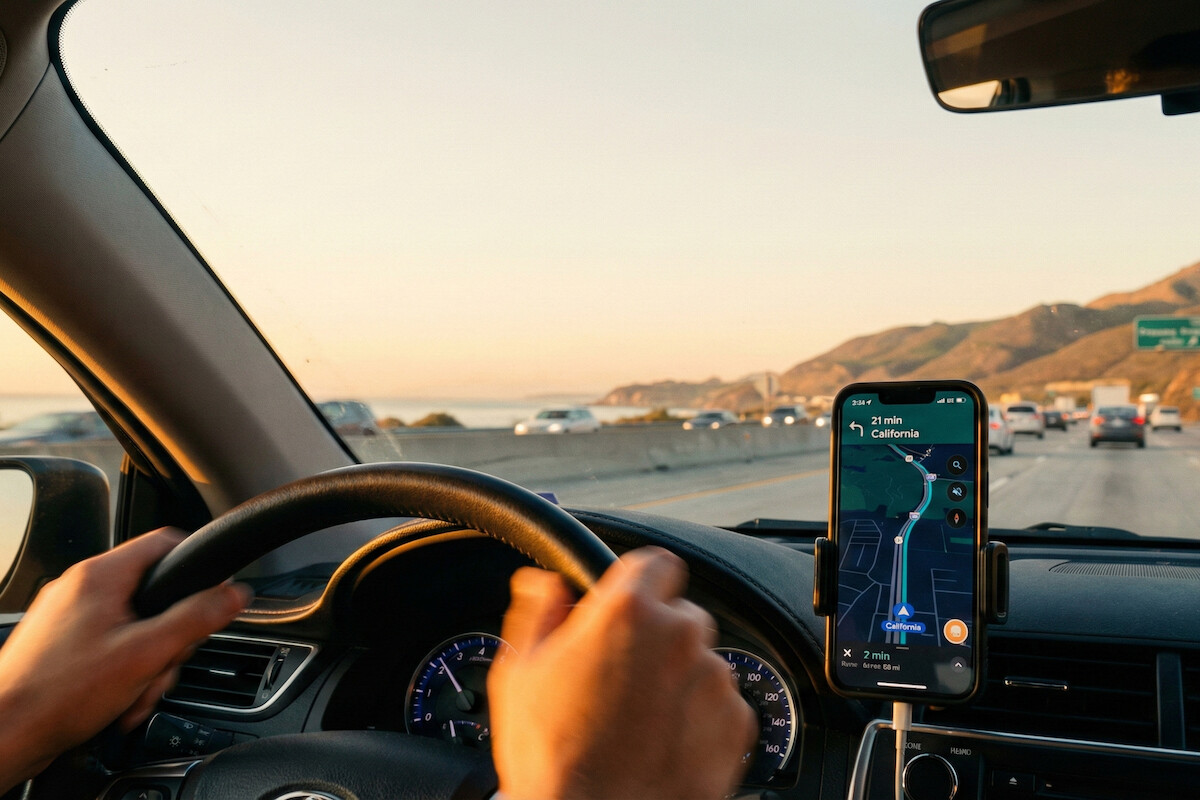
The law allows hands-free use, but with specific requirements. Your phone must be mounted on the windshield, dashboard, or center console in a way that doesn’t block your view. And you can only activate features with a single swipe or tap.
These rules apply even when you’re stopped at a red light or stuck in traffic. Your car is still considered “in operation.” Pick up your phone at a stoplight, and you’re violating the law.
Drivers under 18 face even stricter rules under Section 23124. Teen drivers can’t use any wireless device while driving, period. No hands-free exception. The only thing allowed is an emergency call.
A recent court case made things even clearer. In People v. Porter (2025), the California Court of Appeals ruled that “operating” a phone includes passively viewing it. So the old defense of “I was just looking at my GPS, not using it” no longer works. If you’re holding the phone and looking at it, you’re in violation.
What Are Common Examples of Distracted Driving?
Distracted driving goes beyond phones. Here are behaviors that count:
Phone-related distractions:
- Texting or reading messages
- Making calls without a hands-free setup
- Checking social media or email
- Taking photos or videos
- Using navigation apps while holding the phone
Other common distractions:
- Eating or drinking while driving
- Adjusting the radio, climate controls, or infotainment system
- Talking to passengers (especially animated conversations)
- Grooming (makeup, shaving, fixing hair)
- Reaching for objects in the car
- Reading (yes, some people do this)
- Watching videos on mounted screens
- Dealing with children or pets in the back seat
Some of these are illegal in California. Others are just dangerous. All of them take your attention away from the road.
What Are the Real Consequences of Distracted Driving?
The consequences fall into two categories: what happens if you get caught and what happens if you cause a crash.
Getting Caught
California treats distracted driving violations as infractions. Base fines start at $20 for a first offense and $50 for subsequent offenses. But those numbers are misleading. Once you add penalty assessments, court fees, and surcharges, a first offense actually costs $150 to $162. A second offense runs $250 to $285.
Causing a Crash
This is where things get serious. If your distracted driving causes an accident, you face civil liability for all damages. That includes medical bills, lost wages, pain and suffering, and property damage. If someone dies, you could face wrongful death claims from their family.
Criminal charges are possible, too. Reckless driving charges can apply when distracted driving shows willful disregard for safety. And if someone dies, vehicular manslaughter charges may follow.
How Much Is a Ticket for Distracted Driving in California?
The fine structure looks deceptively small at first glance.
| Offense | Base Fine | Total Cost (with fees) |
|---|---|---|
| First offense | $20 | $150 to $162 |
| Second or subsequent | $50 | $250 to $285 |
Why the huge jump from base fine to total cost? California adds penalty assessments that multiply the base fine, plus court construction fees, emergency medical services fees, and various surcharges. The base fine is almost meaningless.
Beyond the ticket itself, repeat offenders within 36 months receive one point on their driving record. Points stick around for three years and can lead to license suspension if you accumulate too many.
California uses primary enforcement for these laws, meaning officers can pull you over for seeing you use a phone. They don’t need another reason to stop you.
Does a Distracted Driving Ticket Increase Your Insurance?
Yes. Significantly.
California drivers face the highest insurance increases in the nation after a distracted driving ticket. Premiums jump an average of 45% to 51% after a cell phone violation.
In dollar terms, that’s roughly $500 to $900 extra per year. Over the three years the violation stays on your record, you’re looking at $1,800 or more in additional premiums.
Get a second conviction, and you’ll likely lose your “good driver’s discount,” which typically saves about 20% on premiums. Combined with the rate increase from the violation itself, your insurance costs can nearly double.
National averages are somewhat lower. Most insurers increase rates 28% to 43% after a texting ticket. But California’s higher base rates mean the dollar impact hits harder here.
The violation will typically affect your rates for three to five years, depending on your insurer. If the violation involved an accident, expect impacts lasting even longer.
How Do Distracted Driving Laws Differ Across States?
California has strict laws, but it’s not alone. Here’s how other major states handle distracted driving.
State Comparison at a Glance
| State | Handheld Ban | Texting Ban | Enforcement | First Offense Fine | Points |
|---|---|---|---|---|---|
| California | Yes | Yes | Primary | $20 ($150+ total) | 0 (1 for repeat) |
| New York | Yes | Yes | Primary | $50-200 | 5 |
| Illinois | Yes | Yes | Primary | $75 | Moving violation |
| Florida | School/Work zones only | Yes | Secondary | $30 | 0 |
| Texas | School zones only | Yes | Primary | $25-99 | No system |
| Michigan | Yes | Yes | Primary | $100 | 0 (1 for repeat) |
| Georgia | Yes | Yes | Primary | $50 | 1 |
| Nevada | Yes | Yes | Primary | $50 | 0 |
New York
New York bans both handheld phone use and texting under VTL § 1225-c and § 1225-d. Primary enforcement applies statewide, and fines range from $50 to $200 for a first offense, up to $450 for a third. Each conviction adds 5 points to your driving record. Young drivers with learner permits face 120-day suspensions for first offenses.
New York also created designated “Texting Zones” along state highways so drivers can safely pull over to use their phones.
Illinois
Illinois bans all handheld phone use with primary enforcement under 625 ILCS 5/12-610.2. Fines start at $75 for the first offense and climb to $150 for the fourth offense. A January 2024 update expanded the law to specifically ban video conferencing, streaming, and social media while driving.
Florida
Florida takes a lighter approach. Handheld phone use is only banned in school zones and work zones. Texting while driving is illegal statewide, but it’s a secondary offense. That means officers can only cite you for texting if they’ve pulled you over for something else.
Fines reflect this lenient stance. First offense texting tickets run just $30 with no points. A second offense within five years costs $60 and adds 3 points.
Texas
Texas also has limited restrictions. Handheld phone use is banned only in school zones under Texas Transportation Code § 545.425. Texting while driving is banned statewide with primary enforcement, but fines are modest at $25 to $99 for the first offense, $100 to $200 for subsequent violations.
Texas doesn’t use a point system. However, if texting causes serious injury or death, charges escalate to a Class A misdemeanor with up to $4,000 in fines and a year in jail.
Michigan
Michigan joined the strict-law states in June 2023 with a comprehensive handheld ban under MCL 257.602b. Fines are $100 for the first offense and $250 for the second offense, with community service requirements added.
Teen drivers face even tighter restrictions under Kelsey’s Law (MCL 257.602c), which completely bans all cell phone use, including hands-free, for drivers with Level 1 or 2 graduated licenses.
Fines double if the violation causes an at-fault crash.
Georgia
Georgia enacted the Hands-Free Georgia Act in July 2018 under O.C.G.A. § 40-6-241. The law prohibits holding any device with any body part while driving. Primary enforcement applies.
Fines escalate from $50 for the first offense to $150 for the third offense, with 1 to 3 points added respectively. First-time offenders can get charges dropped by showing proof they purchased hands-free equipment.
Like California, the law applies at red lights and stop signs.
Injured by a Distracted Driver?
If someone else’s distracted driving caused your accident, you have options. California law allows accident victims to pursue compensation for medical expenses, lost income, pain and suffering, and other damages.
Distracted driving can be difficult to prove without proper investigation. Phone records, witness statements, and crash reconstruction may all play a role in your case.
Call us or contact us online for a free consultation. Our team can review your situation, explain your rights, and help you understand what your case might be worth. You won’t pay anything unless we recover compensation for you.
DK All the way


From Your Case to Compensation, we take your case all the way.
Schedule a Free Consultation
Get Expert Legal Advice at Zero Cost.
At DK Law we’re with you – all the way.
Get a Free Consultation with our experts today!